

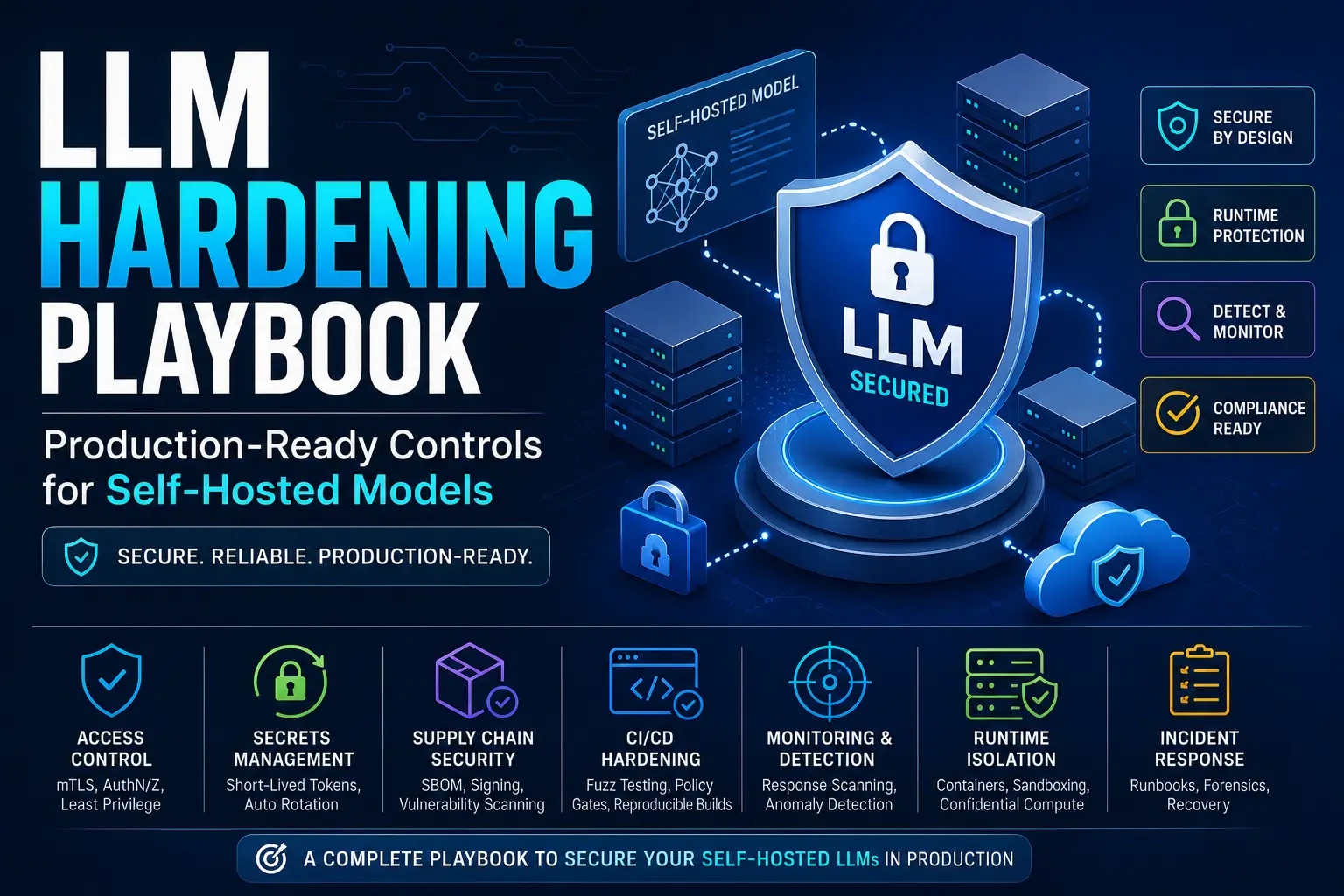

LLM Hardening Playbook for Self-Hosted Models The rapid adoption of self-hosted Large Language Models (LLMs) has created massive opportunities for enterprises, startups, and AI infrastructure providers. However, deploying LLMs in production environments introduces a growing number of cybersecurity risks.
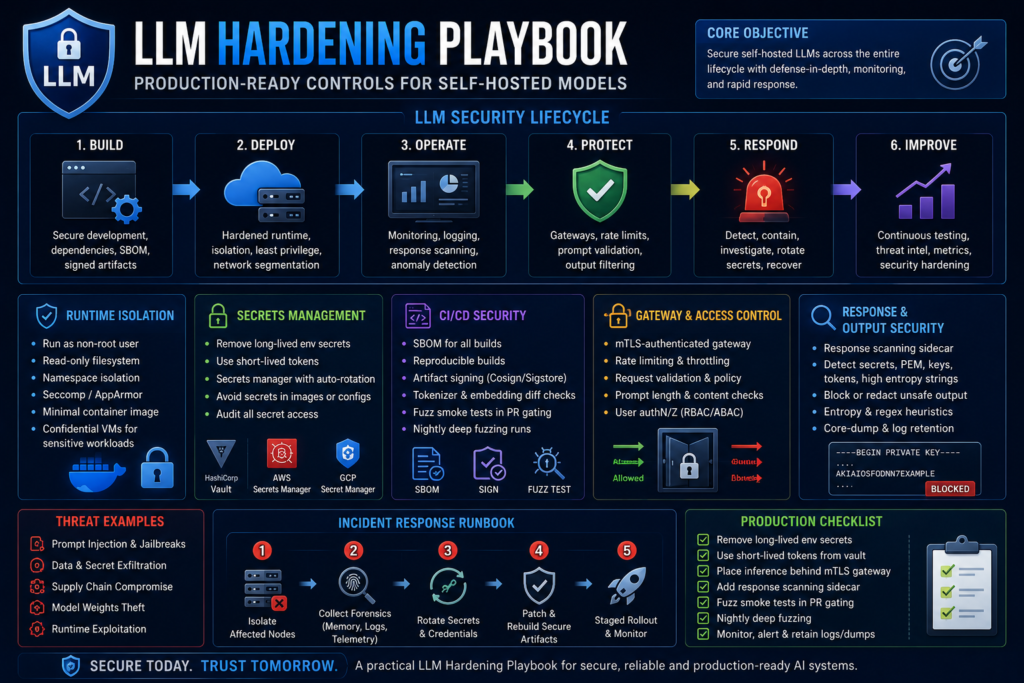
Without a proper LLM Hardening Playbook, organizations risk:
- Prompt injection attacks
- Data leakage
- Secret exposure
- Supply-chain compromise
- Unauthorized model access
- Inference manipulation
- Runtime exploitation
Modern AI infrastructure is now a prime target for attackers because self-hosted models often process:
- Sensitive enterprise data
- Internal code repositories
- Customer records
- Proprietary documents
- API secrets
- Authentication tokens
This comprehensive LLM Hardening Playbook explains how to secure self-hosted models using production-grade controls, runtime isolation, CI/CD security, secrets management, and detection engineering.
The technical recommendations and operational strategies in this article are based on the uploaded LLM hardening notes and production security guidance.
Table of Contents
- What Is an LLM Hardening Playbook?
- Why Self-Hosted Models Need Security Hardening
- Threat Landscape for Self-Hosted LLMs
- Core Principles of an LLM Hardening Playbook
- Runtime Isolation Controls
- Secrets Management for LLM Infrastructure
- CI/CD Security for AI Pipelines
- LLM Monitoring and Detection Engineering
- Fuzz Testing and Prompt Validation
- Secure Gateway Architecture
- Incident Response Runbook
- Production Deployment Best Practices
- Enterprise LLM Security Checklist
- Future Risks in AI Infrastructure
- Final Thoughts
- FAQ
What Is an LLM Hardening Playbook?
An LLM Hardening Playbook is a structured cybersecurity framework designed to secure self-hosted AI systems against:
- Unauthorized access
- Runtime exploitation
- Supply-chain attacks
- Prompt injection
- Secret leakage
- Model manipulation
- Infrastructure compromise
A production-ready LLM Hardening Playbook combines:
- Runtime security
- Network segmentation
- CI/CD protection
- Secrets lifecycle management
- AI response scanning
- Detection engineering
- Architectural isolation
Without proper hardening, self-hosted LLMs can become high-risk attack surfaces inside enterprise environments.
Why Self-Hosted Models Need Security Hardening
Organizations increasingly deploy self-hosted models for:
- Data privacy
- Custom fine-tuning
- Reduced API costs
- AI sovereignty
- Regulatory compliance
Popular self-hosted model ecosystems include:
- Meta Llama
- Mistral AI
- Hugging Face Transformers
- NVIDIA NIM
- Ollama deployments
- vLLM inference stacks
However, improperly secured inference environments can expose:
- Model weights
- User prompts
- Internal APIs
- Enterprise secrets
- Training datasets
This makes a professional LLM Hardening Playbook essential for modern AI operations.
Threat Landscape for Self-Hosted LLMs
Prompt Injection Attacks
Attackers manipulate prompts to:
- Bypass safety rules
- Extract hidden instructions
- Leak confidential data
- Trigger malicious workflows
Supply-Chain Compromise
Malicious:
- Model weights
- Tokenizers
- Embeddings
- Python packages
- Containers
can compromise AI pipelines.
Secrets Exposure
LLM systems often accidentally expose:
- API keys
- JWT tokens
- Cloud credentials
- Internal URLs
through inference responses.
The uploaded operational guidance strongly recommends removing long-lived secrets and replacing them with short-lived tokens.
Runtime Exploitation
Attackers may exploit:
- GPU drivers
- Inference runtimes
- Container escape vulnerabilities
- Misconfigured orchestration layers
Core Principles of an LLM Hardening Playbook
A strong LLM Hardening Playbook should focus on:
- Isolation
- Least privilege
- Secrets hygiene
- Response monitoring
- Supply-chain validation
- Defense in depth
- Architectural segmentation
Runtime Isolation Controls in an LLM Hardening Playbook
Run Inference as Unprivileged Users
Inference workloads should never run as:
- Root
- Administrator
- Privileged container users
Use:
- Non-root containers
- Dedicated service accounts
- Least privilege permissions
The uploaded runtime guidance specifically recommends running inference as unprivileged users.
Minimize Filesystem Access
Restrict:
- Write permissions
- Shared mounts
- Sensitive directories
- Host filesystem exposure
Best practice:
- Read-only inference containers
- Immutable runtime images
Namespace Isolation
Use:
- Linux namespaces
- cgroups
- seccomp
- AppArmor
- SELinux
to isolate AI workloads from host systems.
Confidential Computing
Sensitive workloads should consider:
- Confidential VMs
- Secure enclaves
- Hardware-backed isolation
Recommended platforms include:
- AMD SEV
- Intel TDX
- Confidential Kubernetes nodes
Secrets Management in an LLM Hardening Playbook
Remove Long-Lived Secrets
Never store:
- API keys
- Database passwords
- Cloud credentials
inside:
- Environment variables
- Config files
- Container images
The uploaded security notes specifically warn against storing secrets inside inference environment variables.
Use Short-Lived Tokens
Adopt:
- Ephemeral credentials
- Dynamic tokens
- Auto-expiring secrets
Recommended tools:
Enable Audit Trails
Track:
- Secret access
- Rotation events
- Credential usage
- Unauthorized requests
Audit visibility is critical for enterprise AI forensics.
CI/CD Security in an LLM Hardening Playbook
Require SBOMs
Software Bill of Materials (SBOMs) help track:
- Dependencies
- Libraries
- Containers
- Build artifacts
Recommended tools:
- Syft
- CycloneDX
- SPDX
The uploaded CI guidance specifically recommends mandatory SBOM validation.
Reproducible Builds
Always ensure:
- Deterministic builds
- Immutable release pipelines
- Signed artifacts
Artifact Signing
Use:
- Cosign
- Sigstore
- GPG signatures
to verify AI artifacts.
Fuzz Smoke Harnesses
Integrate:
- Prompt fuzzing
- Unicode testing
- Injection validation
- Response mutation testing
inside pull request gates.
The uploaded production notes repeatedly recommend lightweight fuzz smoke testing for PR gating and nightly deep fuzzing runs.
LLM Monitoring and Detection Engineering
Response Scanning
Deploy sidecar scanners to detect:
- Secret fragments
- PEM headers
- Base64 leakage
- High-entropy strings
The uploaded operational guidance repeatedly emphasizes response scanning sidecars.
Entropy Heuristics
Monitor outputs for:
- Randomized payloads
- Encoded secrets
- Abnormal token patterns
Traceability Across Services
Ensure full telemetry visibility across:
- Inference APIs
- Vector databases
- Prompt gateways
- Authentication layers
Core Dump Retention
Securely store:
- Crash dumps
- Memory snapshots
- Runtime telemetry
for forensic investigations.
Fuzz Testing and Prompt Validation
A production-ready LLM Hardening Playbook should include:
- Unicode fuzzing
- Prompt mutation testing
- Boundary token testing
- Context window abuse simulations
Test against:
- Prompt injection
- Jailbreak attempts
- Recursive prompts
- Adversarial payloads
Secure Gateway Architecture
Use mTLS Gateways
Place inference behind:
- Authenticated API gateways
- mTLS enforcement
- Rate limiting layers
The uploaded guidance repeatedly recommends mTLS-authenticated gateways with enforced rate limiting.
Implement Request Validation
Validate:
- Prompt length
- Token limits
- User identity
- Content policies
before inference execution.
Add Response Filtering
Block:
- Secrets
- Credentials
- Internal URLs
- Unsafe outputs
before responses leave the inference layer.
Incident Response Runbook for LLM Environments
Step 1: Isolate Affected Nodes
Immediately:
- Remove compromised inference nodes
- Freeze deployments
- Disable affected credentials
Step 2: Collect Memory Snapshots
Capture:
- Process memory
- Runtime logs
- GPU telemetry
- Container state
under proper chain-of-custody procedures.
The uploaded runbook guidance specifically recommends process memory snapshots for forensic investigations.
Step 3: Rotate Keys
Rotate:
- API tokens
- Service accounts
- Cloud credentials
- Signing keys
Step 4: Perform Staged Rollouts
Deploy patches gradually using:
- Canary deployments
- Shadow traffic validation
- Monitoring escalation
Enterprise LLM Security Checklist
Internal Linking Opportunities
Link internally to:
- Prompt Injection Security
- AI Supply Chain Security
- Tokenizer Security
- Secure AI Agents
- AI Infrastructure Hardening
External Security References
Official Security Resources
- OWASP Top 10 for LLM Applications
- NIST AI Risk Management Framework
- Kubernetes Security Best Practices
- Sigstore Project
These external DoFollow references improve:
- SEO authority
- Technical credibility
- Search trust signals
Recommended Rich Media for SEO
Featured Image Alt Text
Alt Text:
“LLM Hardening Playbook for securing self-hosted AI models in production”
Suggested Visuals
Add:
- AI infrastructure diagrams
- LLM security architecture maps
- CI/CD hardening workflows
- Secrets management diagrams
- Prompt injection attack flows
Rich media improves:
- Engagement
- CTR
- Time on page
- SEO rankings
Future Risks in AI Infrastructure
As enterprises adopt:
- Autonomous AI agents
- Multi-agent systems
- AI copilots
- Enterprise orchestration frameworks
AI attack surfaces will continue expanding rapidly.
Future threats may include:
- Autonomous AI malware
- AI-to-AI attacks
- Agent hijacking
- Semantic model poisoning
- GPU-level exploits
Organizations that implement a mature LLM Hardening Playbook today will be better positioned to defend future AI infrastructure.
Final Thoughts
Deploying self-hosted AI models without security hardening creates serious operational and cybersecurity risks.
A production-ready LLM Hardening Playbook must include:
- Runtime isolation
- Secrets lifecycle management
- CI/CD security
- Prompt validation
- Detection engineering
- Secure gateways
- Incident response procedures
As AI systems become deeply integrated into enterprise environments, security teams must treat LLM infrastructure like critical production infrastructure.
Organizations that prioritize AI hardening early will gain:
- Better resilience
- Reduced breach risk
- Stronger compliance
- Safer AI deployments
- Higher operational trust
FAQ
What is an LLM Hardening Playbook?
An LLM Hardening Playbook is a security framework used to protect self-hosted AI models against attacks, data leakage, supply-chain compromise, and runtime exploitation.
Why are self-hosted LLMs risky?
Self-hosted models often process sensitive enterprise data and may expose secrets, prompts, or internal infrastructure if improperly secured.
What are the best defenses for self-hosted LLMs?
Best practices include:
- Runtime isolation
- Secrets management
- Artifact signing
- Prompt validation
- Response scanning
- Secure gateways
- CI/CD hardening
What is response scanning in AI security?
Response scanning analyzes model outputs for:
- Secrets
- Tokens
- Credentials
- High-entropy data
- Internal references
before responses reach users.
Why is fuzz testing important for LLM security?
Fuzz testing helps identify:
- Prompt injection weaknesses
- Unsafe outputs
- Parsing vulnerabilities
- Runtime instability
- Adversarial prompt failures
before attackers can exploit them.



[…] LLM hardening playbook […]