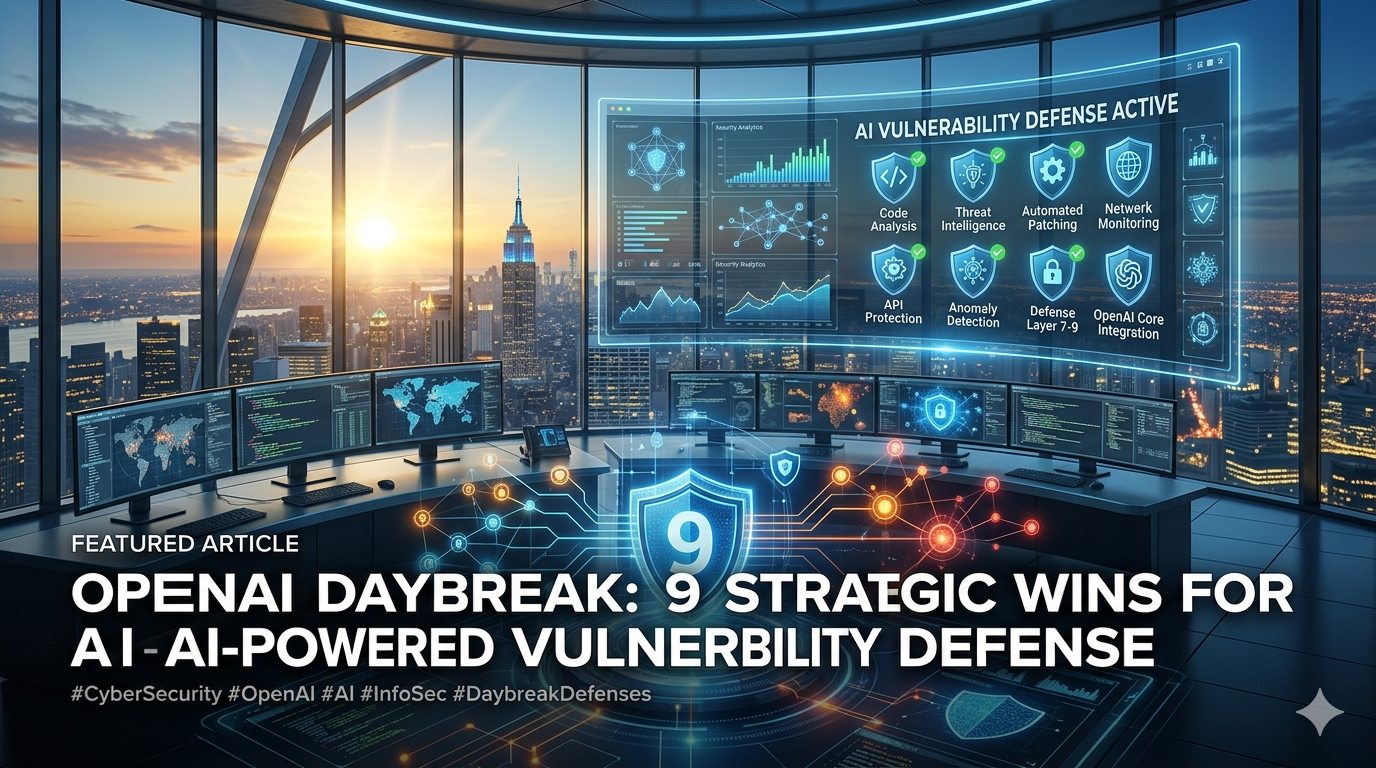

OpenAI Daybreak is a security initiative that folds AI-assisted vulnerability discovery and patch validation into day-to-day engineering. This report explains what Daybreak is, how it changes the vulnerability lifecycle, and how security teams can integrate it without creating new exposure. The focus is practical: deterministic workflows, measurable outcomes, and operational guardrails.
OpenAI Daybreak: Table of contents
- What Daybreak is
- Why it matters now
- 9 strategic wins (and risks)
- Architecture and data boundaries
- Implementation blueprint
- Detection and governance guardrails
- Operational pitfalls
- Metrics that prove value
- FAQ
What OpenAI Daybreak is
Public reporting describes OpenAI Daybreak as a cybersecurity initiative that combines OpenAI models with Codex Security to help organizations identify and patch vulnerabilities, validate fixes, and deliver remediation guidance. It is positioned as a defensive acceleration layer: threat modeling, secure code review, and dependency risk analysis inside authorized environments, with a focus on controlled access.
The key difference is workflow integration. Daybreak is not a standalone scanner. It is designed to sit inside engineering loops, where findings can be turned into fixes with traceable evidence and reproducible tests. That means the output is expected to be actionable, not just informative.
Why OpenAI Daybreak matters now
AI-assisted discovery compresses the time between initial discovery and usable exploit. Security teams face a narrowing window to verify, patch, and deploy fixes. That gap creates risk: triage fatigue, rushed remediation, and unverified patches that introduce new faults. OpenAI Daybreak is a response to this acceleration and aims to rebalance the cycle by making patch validation as fast as discovery.
It also changes accountability. A vulnerability report without a deterministic execution trace is not defensible. Daybreak emphasizes controlled environments, clear scope, and reproducible results that can be audited later. This is how organizations avoid a flood of plausible-sounding but unverified findings.
9 strategic wins from OpenAI Daybreak
- Faster discovery: AI reduces time to identify high-impact flaws while the context is still fresh for engineers.
- Patch validation: fixes can be tested in isolated environments before any production rollout.
- Threat modeling at scale: editable models capture realistic attack paths and keep risk aligned with code changes.
- Dependency risk mapping: supply chain exposure becomes visible earlier, not after an incident.
- Developer enablement: remediation guidance arrives in the same loop where code is written.
- Controlled access: usage is gated for verified defensive work, reducing misuse risk.
- Reduced false positives: structured workflows help curb hallucinated findings.
- Operational alignment: security workflows match CI/CD cadence for faster patch velocity.
- Governance surface: creates audit trails and verification artifacts for compliance.
Architecture and data boundaries
OpenAI Daybreak should be deployed as an internal security service with strict boundaries. The core principle is isolation: analysis happens in a controlled testbed with sanitized data, then findings are mapped back to the source repository. Any system that touches production secrets should be treated as out of scope. This is where Zero Trust M2M must be enforced, so machine-to-machine access is explicit, time-bounded, and scoped to the smallest possible set of resources.
Security leaders should insist on an execution trace for each finding: the repo state, dependency versions, test vectors, and a reproducible command sequence. That trace becomes the basis for audit, verification, and post-incident analysis.
Implementation blueprint
Adoption should start small and expand only after metrics prove value. The fastest path to failure is to run OpenAI Daybreak across every repository without a baseline or a deterministic validation step. Use a phased rollout that aligns with existing security gates.
- Pick one high-value repo: start with code that has both high risk and clear ownership.
- Establish a baseline: run a deterministic scan and capture the execution trace for reproducibility.
- Isolate testbeds: ensure no production data enters the environment; treat it as a lab.
- Human approval: require a security engineer to approve every remediation before merge.
- Patch validation: verify fixes against known exploit paths and regression tests.
- Rollout policy: only expand to additional repos after false-positive rates and cycle time improve.
Detection and governance guardrails
OpenAI Daybreak should operate under Zero Trust M2M principles. Machine-to-machine calls must be authorized per task, scoped to least privilege, and time-bounded. This preserves speed without expanding the blast radius.
- Scope control: authorized environments only; no production data in model context.
- Ephemeral access: time-bounded tokens and least privilege per job.
- Deterministic verification: reproduce every finding with a clean runner.
- Auditability: retain logs, prompts, and diffs for review and compliance.
- Policy gates: require approval for risky remediation or dependency updates.
Operational pitfalls and how to avoid them
Most failures occur in the operational layer, not in the model. These pitfalls create real risk:
- Unverified remediation: merging AI-proposed fixes without deterministic tests can introduce new vulnerabilities.
- Stochastic RCE blind spots: when build steps or plugins execute untrusted code, stochastic RCE can hide behind toolchain variability.
- Over-scoped access: broad access increases blast radius; use least privilege and ephemeral access.
- Missing execution trace: without a reproducible execution trace, findings are not defensible under audit.
- Unbounded scope creep: expansion to low-value repos dilutes security impact and increases cost.
Metrics that prove value
To justify OpenAI Daybreak at scale, tie it to measurable outcomes. These metrics make the case for adoption and prevent shallow deployments:
- Mean time to patch: track cycle time from report to verified fix.
- False-positive rate: compare AI findings to verified issues.
- Regression coverage: percentage of patches with deterministic tests.
- Dependency exposure: number of high-risk libraries mapped and remediated.
- Audit completeness: percentage of findings with full execution trace and approval chain.
Professional guidance for security leaders
OpenAI Daybreak should be deployed like a new security control. Treat AI output as a recommendation, not a decision. The winning pattern is: AI proposes, humans verify, deterministic tests confirm. That chain protects the organization while preserving speed. When a control increases speed without reducing precision, it becomes durable. When it increases volume without verification, it becomes noise.
Internal playbooks
External references
FAQ
Q: Is OpenAI Daybreak available to everyone?
A: Access is reported to be controlled and limited to verified defensive use cases.
Q: How does OpenAI Daybreak reduce false positives?
A: Findings are validated through isolated testbeds and patch verification steps.
Q: What is the fastest safe way to start?
A: Start with one repository, capture a deterministic execution trace, and require human approval for every patch.
Risk scenarios security teams should model
Before full adoption of OpenAI Daybreak, model realistic failure modes. A high-confidence AI finding that cannot be reproduced is operationally useless. A patch that passes unit tests but fails under production traffic can cause outages. Model the risk that a code suggestion modifies authentication logic or logging semantics. Use a defined review checklist that includes security impact, performance impact, and rollback safety.
Include dependency scenarios. If the AI recommends updating a transitive library, validate the change against SBOM policies and verify signature provenance. These steps are not optional; they protect you from accidental supply chain drift.
How to integrate with CI/CD without slowing delivery
Daybreak should not become a new bottleneck. The practical pattern is to run AI-assisted validation in parallel with existing CI checks. Use feature flags to route only high-risk changes for deeper analysis. Keep the feedback loop tight: if a finding cannot be validated within the same sprint, it should be logged for later remediation rather than blocking a release with low confidence.
For high-value services, create a security quality gate that requires verified fixes for critical findings while allowing lower-severity issues to be queued. This keeps throughput predictable and reduces the risk of a stalled engineering pipeline.
Case study pattern (hypothetical)
Consider a payment microservice that uses a third-party serialization library. OpenAI Daybreak identifies a memory safety issue and proposes a patch. The security team runs the finding in an isolated testbed, reproduces the issue, and validates the fix. The patch is then run through regression tests and a canary deployment. The result is a verified remediation with a full execution trace and a clean rollback path. This is the workflow standard that makes Daybreak valuable.
Checklist for secure adoption
- Confirm scope: authorized environments only.
- Define deterministic reproduction steps for every finding.
- Require human approval for patch merges.
- Log every AI action and diff for audit.
- Use ephemeral tokens and least privilege access.
- Verify dependency updates with SBOM and signature checks.
- Measure cycle time and false-positive rates each sprint.