
The 2026 AI War: Claude Fable 5 vs. OpenAI GPT-5.5 vs. Alibaba Qwen 3
In the 2026 frontier AI race, comparing Claude Fable 5 vs GPT-5.5 has become the central focus for enterprise developers deploying agentic models.
With Anthropic’s launch of Claude Fable 5, the competition between the Western giants (Anthropic and OpenAI) and the surging Eastern contenders (Alibaba and DeepSeek) has entered a critical new phase.
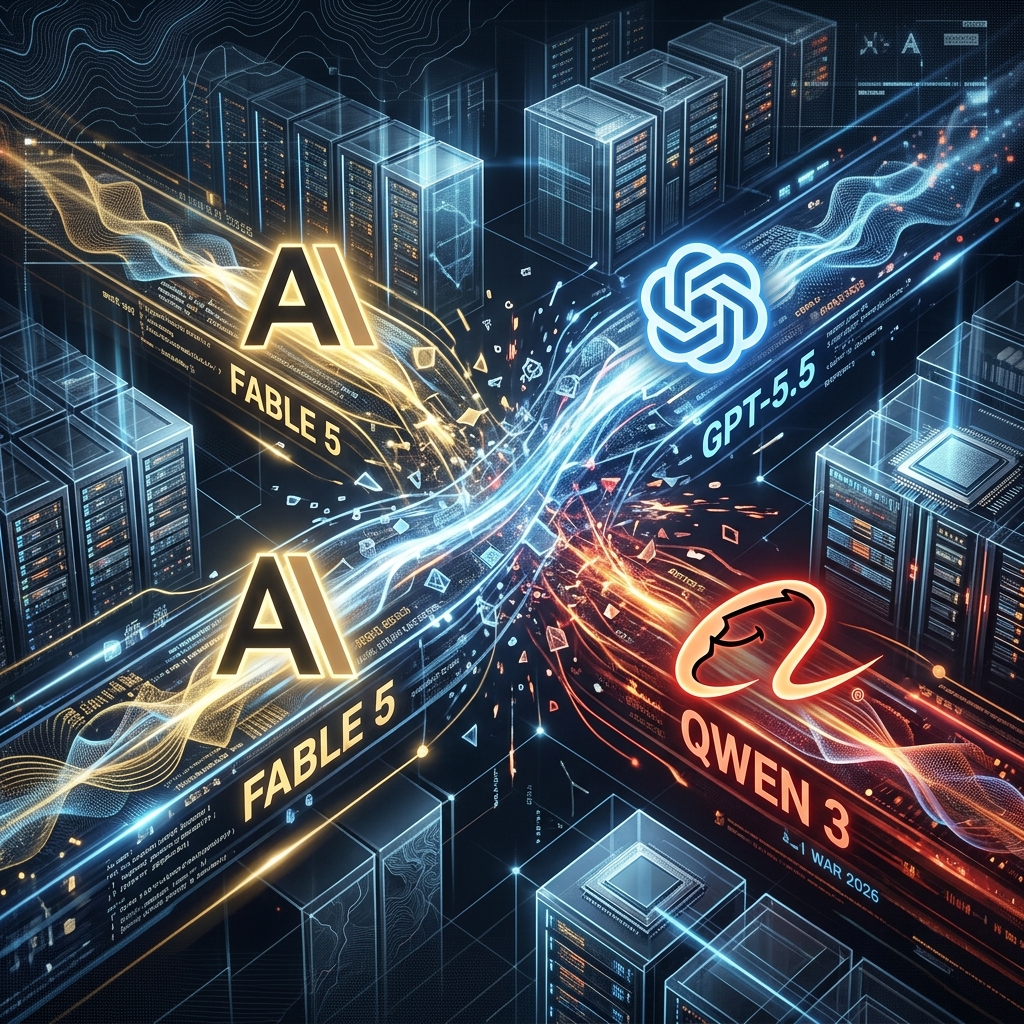
In this Claude Fable 5 vs GPT-5.5 analysis, we stack Anthropic’s flagship against OpenAI’s latest model and Alibaba’s Qwen 3.7 Max to see who leads the charge in this new autonomous era.
The Contenders at a Glance
Each AI laboratory has taken a distinct path in their mid-2026 releases:
- Anthropic (Claude Fable 5): Focused heavily on long-horizon planning, self-verification, and native tool-use guardrails.
- OpenAI (GPT-5.5 & GPT-5.5 Instant): Emphasizing high-frequency iteration, low latency, and multimodal integrations. OpenAI has sunsetted its reasoning-focused o3 model in favor of the newer GPT-5.5 architectures.
- Alibaba (Qwen 3.7 Max): The flagship open-weights giant, recognized for its extraordinary coding skills and cost-efficient agentic structures.
- DeepSeek (V4): The ultimate market disruptor, offering 90–95% of Western frontier capabilities at a fraction of the API cost.
Claude Fable 5 vs GPT-5.5: Long-Horizon Autonomy
The key differentiator in 2026 is autonomy. A standard benchmark tests an AI model’s ability to plan and execute tasks requiring more than 100 sequential steps (e.g., setting up a database, writing an API wrapper, testing it, and fixing deployment errors).
Long-Horizon Autonomy Success Rates (100+ Steps):

Claude Fable 5:  ██████████████████████████████ 82.9%
Qwen 3.7 Max:    ███████████████████████░░░░░░░ 65.4%
OpenAI GPT-5.5:  █████████████████░░░░░░░░░░░░░ 48.5%
DeepSeek V4:     ██████████████░░░░░░░░░░░░░░░░ 42.1%
Fable 5 is built from the ground up for this circular, agentic workflow. Its native self-verification loop gives it a major edge.
While GPT-5.5 remains incredibly fast and powerful for single-turn complex prompts, it struggles to maintain state and coherence over long, self-directed execution paths without being wrapped in custom developer scaffolding.
Coding and Software Engineering
Coding benchmarks have reached near-saturation on simple tasks, shifting the focus to real-world software maintenance. On SWE-bench Verified, which measures an AI’s ability to resolve actual GitHub issues in complex libraries:
- Claude Fable 5 leads the pack at 84.8%, utilizing its self-verification and sandboxed compilation loops to refine patches.
- Qwen 3.7 Max follows closely at 81.2%, solidifying Alibaba’s reputation as a top-tier choice for developers who prefer open-weight architectures.
- OpenAI GPT-5.5 scores 76.2%. Although highly capable, developers note that it occasionally exhibits regression tendencies on legacy codebases compared to Fable 5.
- DeepSeek V4 scores 73.8%, representing an incredible value proposition given its pricing.
Developer Sentiment & The Cost-Performance Pressures
While capability is crucial, the cost of API calls has become a primary bottleneck for enterprise agent deployments. Running an agent that makes thousands of calls a day gets expensive fast.
| Model | Input Cost | Output Cost | Efficiency Focus |
|---|---|---|---|
| Claude Fable 5 | $3.00 | $12.00 | Premium Long-Horizon Agent |
| OpenAI GPT-5.5 | $2.50 | $10.00 | Latency and Multimodal |
| Qwen 3.7 Max | $1.00 | $3.00 | Cost-Optimized Agentic |
| DeepSeek V4 | $0.14 | $0.28 | Hyper-Disruptive Pricing |
This pricing model has created a split in developer sentiment:
* Premium Workflows: Enterprise developers deploy Claude Fable 5 or GPT-5.5 for high-stakes, mission-critical tasks (like financial auditing or automated security patch generation).
* Scalable Automation: Teams increasingly migrate to Qwen 3.7 Max or DeepSeek V4 for massive-scale operations where cost-efficiency is the primary concern.
The Verdict
Anthropic’s Claude Fable 5 has established itself as the premier model for true autonomous operations, but the competition is closer than ever.
In our final article of this series, we will examine the geopolitical underpinnings of this AI war: how the safety guardrails implemented by Western firms impact their competitive positioning against the unrestricted, rapid distribution of Chinese open-weight models.
Frequently Asked Questions (FAQ)
Which model is better: Claude Fable 5 or OpenAI GPT-5.5?
For autonomous, multi-step agentic workflows and coding tasks, Claude Fable 5 leads with its native self-verification mechanisms. For single-turn queries, low-latency applications, and multimodal integration, OpenAI GPT-5.5 remains highly competitive.
How does Alibaba Qwen 3.7 Max compare in pricing?
Qwen 3.7 Max is significantly more cost-efficient, charging $1.00 per million input tokens and $3.00 per million output tokens, which is less than half the cost of Fable 5 and GPT-5.5, while offering comparable coding benchmarks.
Why did OpenAI sunset the o3 reasoning model?
OpenAI initiated a sunset period for o3 in favor of integrating reasoning capabilities directly into the core GPT-5.5 architecture, simplifying API usage and improving computational efficiency.
What is the primary advantage of DeepSeek V4?
DeepSeek V4 offers hyper-disruptive pricing ($0.14 input, $0.28 output per million tokens) while achieving 90–95% of Western frontier model performance, making it highly attractive for cost-sensitive developers.
Recommended Reading: To understand the security guardrails and geopolitical elements governing these models, continue reading here: AI Guardrails & Geopolitics: Claude 5’s Defenses vs. Chinese Model Proliferation.