

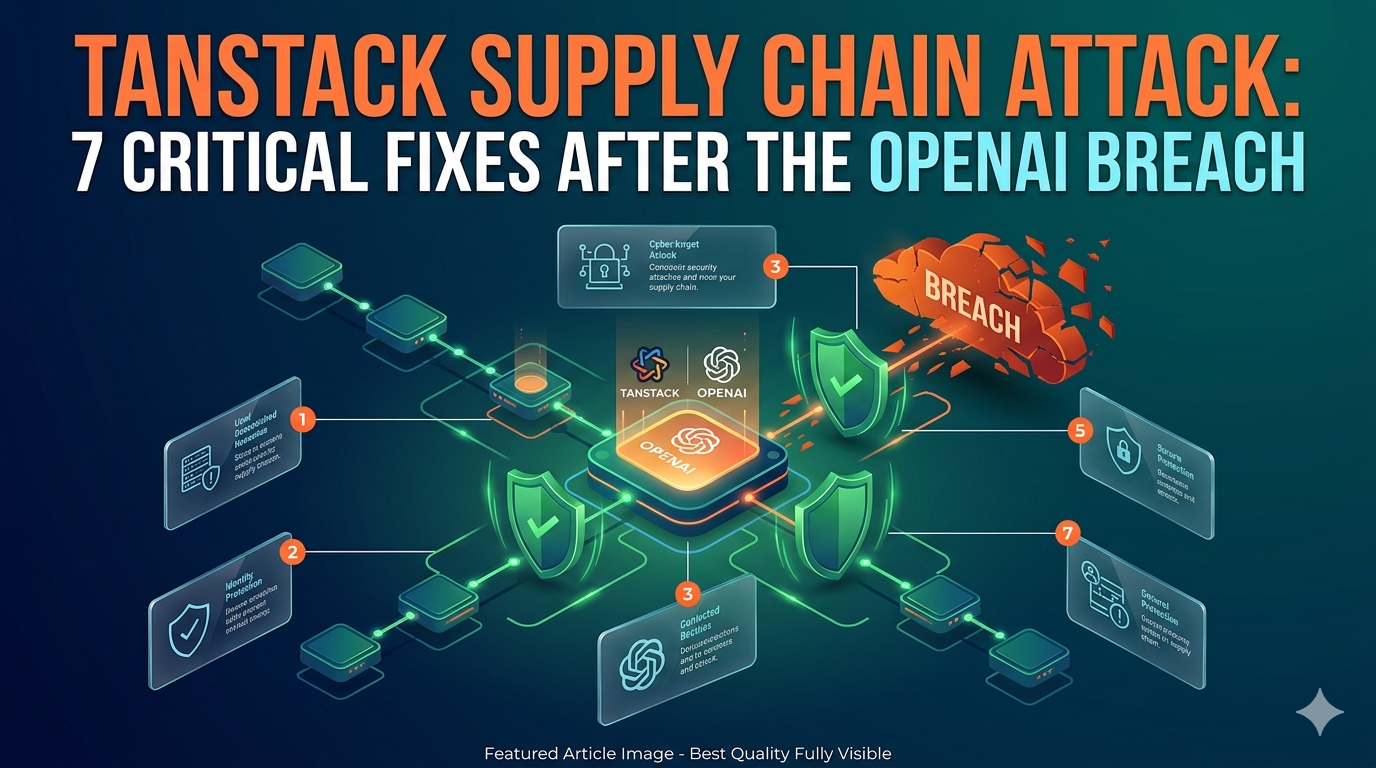

TanStack supply chain attack analysis begins with the observable facts: OpenAI reported two employee devices impacted via malicious TanStack packages, with no user data or production systems compromised. This brief maps the CI cache token theft chain, the code-signing blast radius, and a remediation blueprint you can apply immediately.
TanStack supply chain attack: Table of contents
- Incident summary
- Attack propagation path
- Why CI cache token theft is a force multiplier
- Code-signing blast radius
- 7 critical fixes (short-term + long-term)
- Detection signals
- FAQ
Incident summary
Public reporting confirms that compromised TanStack packages were installed on two OpenAI employee devices. OpenAI stated there was no evidence of user data loss, production compromise, or unauthorized IP modification. However, it rotated macOS code-signing certificates and required users to update specific desktop apps. The incident underscores that a CI cache trust chain can expose a publish token at creation time.
Attack propagation path
- Attacker gains a path into upstream build/publish workflow.
- Publish token is exposed through a CI cache trust chain.
- Malicious packages are published to registries.
- Developers install packages locally; malware executes.
- Credential-focused exfiltration targets internal repositories.
- Organizations detect and rotate credentials and certificates.
Why CI cache token theft is a force multiplier
CI caches are treated as performance optimizations, not security boundaries. That assumption is wrong. A cache trust chain that exposes a publish token can bypass phishing and turn automation into the attacker’s release pipeline. This deterministic execution trace applies to most modern CI/CD stacks.
Code-signing blast radius
Code-signing keys are the last trust boundary between your software and the user’s machine. If developer devices or build systems are touched, signing workflows are inside the blast radius. Rotation and forced updates are the minimal viable response.
7 critical fixes after a TanStack supply chain attack
- Freeze automation: disable automated publish workflows; require manual approvals.
- Rotate and revoke: rotate CI tokens, package publish keys, and developer credentials.
- Endpoint triage: isolate affected devices and collect forensic artifacts.
- Verify releases: confirm no unauthorized binaries were signed or distributed.
- Short-lived OIDC tokens: issue tokens only at publish time and bind to job state.
- Hermetic builds: treat caches as untrusted input; clear caches for release pipelines.
- SLSA + Sigstore: require provenance and signature checks before publish and install.
Detection signals to deploy now
TanStack supply chain attack CI pipeline anomalies
- Unexpected cache write/read activity outside build steps
- Publish attempts from unusual CI jobs or environments
- Build steps accessing tokens not declared in job scope
Package registry anomalies
- Sudden spikes in new versions of popular packages
- Publish events outside maintainer working hours
- Version bumps that only change build scripts or post-install hooks
Endpoint and repo signals
- New scheduled tasks after package install
- Unexpected network calls to unfamiliar domains during builds
- Credential access patterns unrelated to active tasks
Related internal playbooks
External references
FAQ
Q: Why is this TanStack supply chain attack different from a normal package compromise?
A: A CI cache trust chain exposed a publish token, enabling automated compromise at scale.
Q: Why rotate code-signing certificates if production is safe?
A: Developer device compromise puts signing workflows in blast radius; rotation protects downstream users.
Q: Fastest defensive win?
A: Short-lived OIDC publish tokens and cache-free release builds.



[…] TanStack supply chain incident […]