

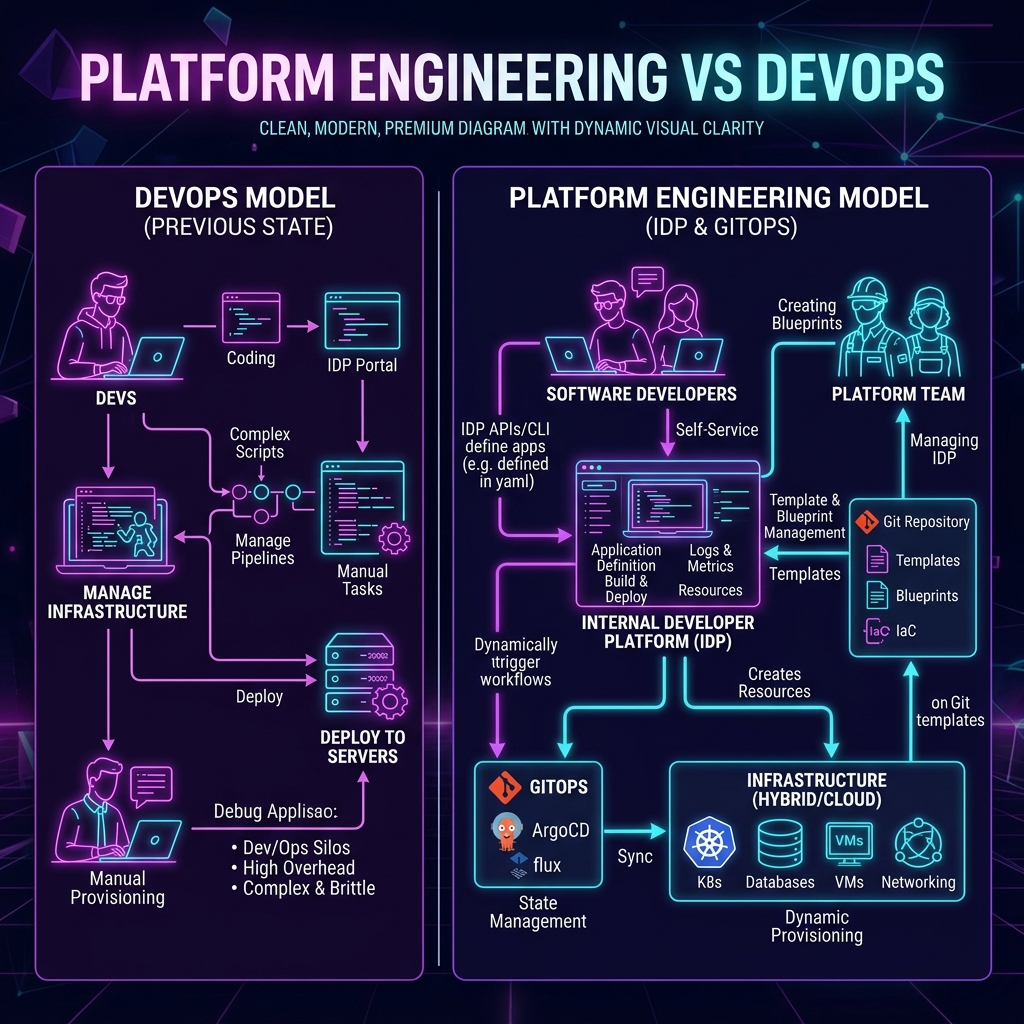

In the rapidly evolving landscape of cloud-native development, the comparison of Platform Engineering vs DevOps has become the defining architectural debate of 2026. For over a decade, DevOps was heralded as the ultimate methodology to break down organizational silos and accelerate software delivery. However, as cloud environments grew in complexity, the “you build it, you run it” philosophy began to overwhelm developers. Today, progressive technology organizations are transitioning toward platform engineering to restore developer velocity and maintain robust security guardrails.
At its core, Platform Engineering vs DevOps represents a shift from a cultural methodology to a product-centric delivery model. While DevOps focus areas center on collaborative workflows and automated pipelines, platform engineering builds upon these foundations by design. It introduces an Internal Developer Platform (IDP) that abstracts away the underlying infrastructure, allowing software engineers to deploy workloads independently and securely. In this comprehensive guide, we compare these two paradigms and explain why enterprise organizations are upgrading their operational structures.
Table of Contents
- Why Platform Engineering vs DevOps Has Become the Defining 2026 Debate
- The Cognitive Load Crisis in Modern DevOps
- What is Platform Engineering and the IDP?
- Resolving the Platform Engineering vs DevOps Friction Point
- Core Components of an Internal Developer Platform
- The 2026 Tooling Landscape: Backstage, Crossplane, and Beyond
- The Platform Engineering Transition Checklist for CTOs
- Conclusion: Scaling DevOps with Platform Products
Why Platform Engineering vs DevOps Has Become the Defining 2026 Debate
To understand the debate surrounding Platform Engineering vs DevOps, we must look at how modern cloud systems have scaled. Historically, DevOps aimed to unify development and operations teams. Software engineers were tasked not only with writing application logic but also with configuring Terraform scripts, managing Kubernetes manifests, establishing IAM roles, and debugging CI/CD pipelines. This model worked well for small startups, but as enterprises migrated thousands of microservices to multi-tenant environments, the requirements became unmanageable.
DevOps is a set of practices, culture, and philosophies. Platform engineering, on the other hand, is the concrete implementation of those practices via dedicated platform teams who treat the development environment as a product. The target of platform engineering is to construct “Golden Paths”—pre-packaged, secure, and fully automated deployment templates that software developers can consume on-demand.
The Cognitive Load Crisis in Modern DevOps
The primary driver behind the shift to platform engineering is developer cognitive overload. When software engineers spend 40% of their work week writing Kubernetes YAML files, configuring network policies, and troubleshooting cloud IAM permissions, their time spent on actual product features drops dramatically. The “shift left” security movement, while noble, forced developers to become security experts, systems administrators, and cloud architects all at once.
This overload leads to several organizational bottlenecks:
– Configuration Drift: Developers copy-paste outdated Terraform or Docker configurations, introducing security vulnerabilities across namespaces.
– Deployment Anxiety: Without standard deployment paths, developers fear breaking production setups, slowing down release cycles.
– Security Vulnerabilities: Misconfigured container permissions or wide IAM roles expose clusters to compromises. To avoid these risks, platform teams should enforce strict base settings. Review our checklist on Docker Container Hardening to secure container builds before they enter the deployment pipeline.
What is Platform Engineering and the IDP?
Platform engineering is the discipline of designing and building toolchains and workflows that enable self-service capabilities for software engineering teams. The output of a platform team is the Internal Developer Platform (IDP). The IDP is a centralized portal (often built on open-source frameworks like Backstage) that acts as the single pane of glass for developer operations.
Instead of logging into AWS, GCP, GitHub, and Jira separately to deploy a new service, a developer uses the IDP to:
1. Scaffold a new repository with built-in CI/CD pipelines, Dockerfiles, and test suites.
2. Provision cloud databases, cache clusters, and storage buckets using self-service templates.
3. Track application health, logs, and cost metrics directly from a unified dashboard.
Resolving the Platform Engineering vs DevOps Friction Point
It is important to note that the debate of Platform Engineering vs DevOps is not a zero-sum game. Platform engineering does not replace DevOps; rather, it scales DevOps principles for larger organizations. DevOps defines *how* teams should collaborate and automate, while platform engineering provides the *infrastructure and tools* that make that collaboration effortless. The platform team essentially acts as a service provider to internal developers, ensuring that operational best practices, security guardrails, and compliance checks are hardcoded into the platform itself.
Let’s compare the core differences across key dimensions of software delivery:
| Operational Area | DevOps (Cultural Paradigm) | Platform Engineering (Product Paradigm) |
|---|---|---|
| Core Philosophy | You build it, you run it (Shared responsibility) | Product-managed developer platform (Self-service) |
| Delivery Mechanism | Distributed CI/CD, scripting, and YAML templates | Centralized Internal Developer Platform (IDP) |
| Infrastructure Management | Manual Infrastructure-as-Code (Terraform/Ansible) | Self-service infrastructure catalogs via GitOps |
| Security Guardrails | Shift-left scanning, developer audits | Security-by-design templates, policy as code |
| Target Metric | Deployment frequency, Lead time for changes | Developer Experience (DevEx), Time to market |
Core Components of an Internal Developer Platform
A production-grade IDP must incorporate multiple layers of automation to be effective. For teams building out these developer portals, security must be baked into every automated workflow from day one. When provisioning Kubernetes clusters or cloud infrastructure dynamically, zero-trust policies must be configured by default. Refer to our architectural checklist on Kubernetes Zero Trust Hardening to learn how to lock down namespaces, establish network micro-segmentation, and secure control plane components automatically.
Additionally, modern IDPs use machine-to-machine authentication tokens to trigger deployments across cloud accounts. Securely managing these service credentials is critical to preventing cluster hijacking. We recommend examining the Non-Human Identity (NHI) Crisis Blueprint to implement secure service account authentication and secret rotation within your platform.
The 2026 Tooling Landscape: Backstage, Crossplane, and Beyond
The platform engineering ecosystem has matured significantly. While early setups relied on custom scripts and manual configurations, modern platform teams leverage a standardized toolchain to construct their IDPs:
– **Developer Portals:** Spotify’s open-source Backstage is the industry standard for developer portals, offering service catalogs, software templates, and documentation in a single interface.
– **Infrastructure Provisioning:** While Terraform remains popular, Crossplane has emerged as a leader by extending the Kubernetes API to manage external cloud resources via GitOps controllers.
– **GitOps and Continuous Delivery:** ArgoCD and Flux automate cluster state reconciliation directly from git repositories, ensuring that live infrastructure always matches declared configurations.
The Platform Engineering Transition Checklist for CTOs
If your organization is planning to transition from distributed DevOps teams to a structured platform engineering model, follow this step-by-step strategic roadmap:
– **Treat the Platform as a Product:** Hire a dedicated Product Manager (PM) for the platform team. Survey internal developers to identify their primary friction points and design the platform around their feedback.
– **Identify and Map Golden Paths:** Define the most common workflows (e.g., creating a Node.js microservice, deploying a static site) and automate them completely. Start with one path and scale incrementally.
– **Standardize GitOps Workflows:** Enforce infrastructure updates via Git pull requests rather than direct terminal commands, securing the deployment audit trail.
– **Hardcode Security Policies:** Build automated security scanners, container hardening templates, and linting checks directly into the platform’s CI/CD pipeline.
– **Measure Developer Experience (DevEx):** Track metrics like Developer Net Promoter Score (DevNPS), onboarding time (time to first commit), and deployment lead times to measure the platform’s ROI.
Conclusion: Scaling DevOps with Platform Products
Ultimately, the choice of Platform Engineering vs DevOps is not about choosing one over the other; it is about scaling your operational capabilities. By establishing dedicated platform teams and building structured, secure Internal Developer Platforms, tech companies can reduce developer cognitive load, accelerate software delivery, and guarantee that security policies are met at every step of the development lifecycle. As organizations continue to scale their cloud-native systems, platform engineering represents the future of enterprise software operations.
For more details on platform tools, explore the official listings on the CNCF Cloud Native Landscape and the developer resources on the Platform Engineering Community Portal.