
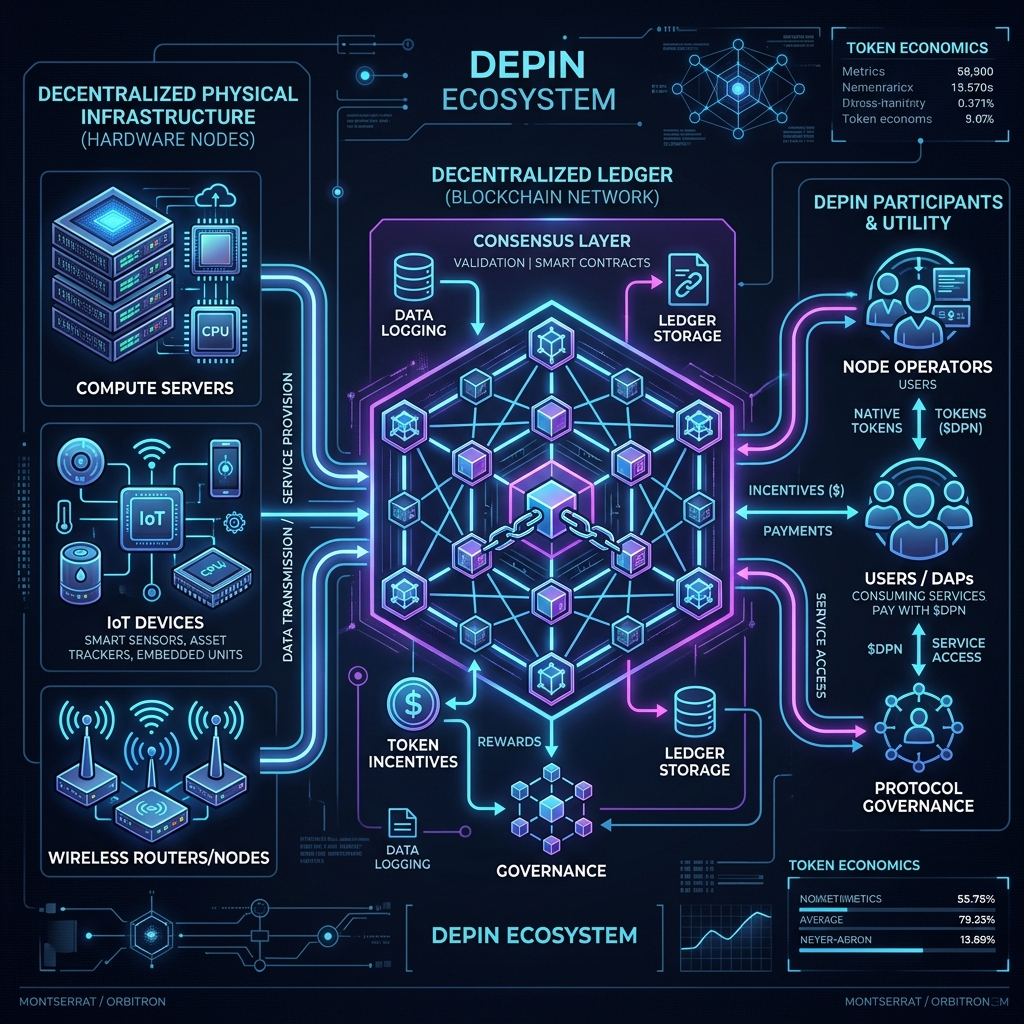

In the rapidly evolving world of decentralized technology, the DePIN Blockchain movement represents a massive paradigm shift. Historically, Web3 was dominated by purely digital assets, decentralized finance (DeFi), and speculative trading. However, in 2026, Decentralized Physical Infrastructure Networks (DePIN) have emerged as the foundational layer for physical resource sharing, bridging the gap between blockchain incentive structures and tangible hardware infrastructure.
A DePIN Blockchain network leverages tokenomics and smart contracts to crowdsource physical facilities, such as GPU computing clusters, data storage servers, wireless nodes, and environmental sensors. By offering cryptographic proof of work and automatic compensation, these systems eliminate centralized monopolies like Amazon Web Services (AWS) or Google Cloud, creating a fairer, more resilient digital economy. In this article, we explore how this infrastructure works and the 7 critical trends driving its growth.
Table of Contents
- Why the DePIN Blockchain Narrative is Dominating 2026
- How the DePIN Flywheel Drives Real-World Value
- The GPU and Decentralized Compute Revolution
- Why Solana Has Become the Hub for DePIN Networks
- Evaluating DePIN Blockchain Security and Scalability
- Top DePIN Projects to Watch in 2026
- The Hardware Deployment and Node Setup Checklist
- Conclusion: The Infrastructure of Tomorrow
Why the DePIN Blockchain Narrative is Dominating 2026
The core promise of a DePIN Blockchain is simple: decentralizing real-world utilities. Centralized data centers are expensive, represent single points of failure, and are highly susceptible to censorship and regional outages. For example, platform teams seeking high security and resilience for their deployments are increasingly exploring distributed networks. This shift mirrors the security practices detailed in our guide on Kubernetes Zero Trust Hardening, which highlights why traditional centralized perimeters are obsolete.
DePIN is generally categorized into two main types of networks:
1. Physical Resource Networks (PRNs): Location-dependent networks where contributors deploy physical hardware to offer localized services, such as decentralized wireless hotspots (DeWi) or environmental mapping sensors.
2. Digital Resource Networks (DRNs): Location-independent networks where contributors offer digital resources like GPU compute power, data storage, or bandwidth from anywhere in the world.
By leveraging smart contracts, a DePIN Blockchain automates transaction verification, resource auditing, and token emissions. This removes the middleman, passing cost savings directly to the consumers while rewarding the hardware providers.
How the DePIN Flywheel Drives Real-World Value
At the center of any successful DePIN Blockchain project is the “DePIN Flywheel”. This economic loop explains how token incentives bootstrap real-world supply before customer demand is fully established. In traditional infrastructure projects, building a network requires massive upfront capital expenditure (CapEx) from a single company. DePIN solves this “cold-start” problem by issuing token rewards to early adopters who deploy hardware, offsetting their setup costs.
The flywheel operates through four main stages:
– Supply Bootstrapping: Token rewards attract hardware operators (miners/node hosts) who join the network to earn yield.
– Cost Reduction: As the network grows, aggregate supply increases, driving down service costs for end-users.
– Demand Capture: Lower prices and higher uptime attract customers (e.g., developers, enterprise customers).
– Token Appreciation: Customer payments burn tokens or buy them back from the market, increasing token value, which in turn attracts more supply providers.
To see how DePIN compares to traditional hyper-scalers, review the architectural differences below:
| Feature | Traditional Cloud (AWS/Azure) | DePIN Blockchain Alternative |
|---|---|---|
| Capital Expenditure | Billion-dollar corporate investments | Crowdsourced by independent operators |
| Pricing Model | Monopolistic pricing with markup | Market-driven, up to 70% cheaper |
| Failure Risk | Centralized data center outages | Globally distributed node network |
| Governance | Board of Directors and corporate SLAs | On-chain DAOs and smart contracts |
The GPU and Decentralized Compute Revolution
One of the most high-traffic subsectors in 2026 is decentralized compute. The massive explosion of Large Language Models (LLMs) and generative AI has created an unprecedented global shortage of high-end H100, A100, and RTX 4090 GPUs. Centralized providers have long waiting lists and command exorbitant rates. A DePIN Blockchain platform solves this compute bottleneck by aggregating spare GPU resources from gaming rigs, mining farms, and enterprise clusters.
Through token incentives, contributors earn passive income by renting out idle GPU computing capacity. AI researchers and developers can access these clusters on-demand for model training, rendering, and inference at a fraction of the standard cost. By distributing the compute loads across thousands of independent nodes, DePIN projects democratize access to machine learning capabilities worldwide.
Why Solana Has Become the Hub for DePIN Networks
While Ethereum pioneered smart contracts, Solana has established itself as the premier layer-1 chain for the DePIN Blockchain ecosystem. The reason is simple: DePIN projects require real-time state tracking, rapid microtransactions, and low gas fees. If a network has to track thousands of GPS coordinates or bandwidth packets per second, high transaction fees make the system economically unviable.
Solana provides:
– Sub-Second Block Times: Ensuring state changes are written almost instantly.
– Ultra-Low Gas Fees: Often costing fractions of a cent ($0.00025 per transaction).
– State Compression: Allowing projects to mint millions of hardware-linked NFTs (representing device ownership) for a few hundred dollars.
– Robust SDKs: Facilitating machine-to-machine payments without complex intermediary layers.
Evaluating DePIN Blockchain Security and Scalability
As DePIN architectures scale, security remains a paramount concern. Because these networks rely on untrusted, consumer-grade hardware to run computations or store data, developers must implement robust encryption and sandboxing. If you are hosting a containerized database or compute workload on a public node, the node operator must not be able to read your proprietary data or inject malicious system calls. This is why securing containers is vital. Read our complete guide on Docker Container Hardening to understand how sandboxing, namespaces, and capabilities prevent host privilege escalations.
Moreover, DePIN networks rely on automated service accounts to trigger on-chain transactions. Securing these credentials requires a deep understanding of machine identity management. We recommend reviewing the Non-Human Identity (NHI) Crisis Blueprint to see how to securely handle service account credentials and prevent keys from being leaked in distributed deployments.
Top DePIN Projects to Watch in 2026
Several pioneer projects have successfully demonstrated the feasibility of DePIN in the real world:
– Helium (DeWi): A decentralized wireless network where users host physical hotspots to provide low-power LoRaWAN and 5G cellular coverage, earning mobile tokens for data routing.
– Render Network (Decentralized Compute): A peer-to-peer GPU rendering network that connects artists requiring rendering power with GPU providers, facilitating high-resolution digital art creation.
– Filecoin (Decentralized Storage): A robust data storage marketplace where independent storage miners rent out hard drive space, secured by cryptographic proofs of storage.
– Hivemapper (Decentralized Mapping): A crowdsourced mapping network where drivers install dashcams that automatically collect high-quality street-level imagery, updating global map databases in real-time.
The Hardware Deployment and Node Setup Checklist
If you are planning to participate in a DePIN Blockchain network as a hardware operator, follow this baseline checklist to ensure your node remains highly secure, performant, and compliant:
- Select Dedicated Hardware: Never host nodes on your personal computer. Use dedicated, isolated devices (such as a Raspberry Pi, a dedicated mini-PC, or a clean mining rig).
- Isolate Network Traffic: Place all DePIN hardware on a segregated guest network or a dedicated VLAN to prevent a compromised node from accessing your home or office local network.
- Enforce Firewall Rules: Block all incoming ports except those explicitly required by the project. Configure your router to reject unauthorized outbound connections.
- Keep Software Updated: Set up automated cron jobs to install security updates and patch container runtimes routinely.
- Monitor Node Performance: Use open-source telemetry tools (like Prometheus and Grafana) to track bandwidth usage, thermal thresholds, and hardware health to prevent downtime penalties.
Conclusion: The Infrastructure of Tomorrow
The DePIN Blockchain paradigm is proving that decentralized networks can build, run, and scale physical infrastructure faster and cheaper than traditional megacorporations. By combining open-source software with cryptographically secured token incentives, DePIN offers a democratic and resilient roadmap for the future of cloud computing, telecommunications, and internet connectivity. As we move deeper into 2026, the convergence of DePIN and artificial intelligence will continue to redefine the boundaries of what decentralized networks can achieve.
For more details on deploying decentralized nodes, consult the official developer guides on the Solana Developer Portal.