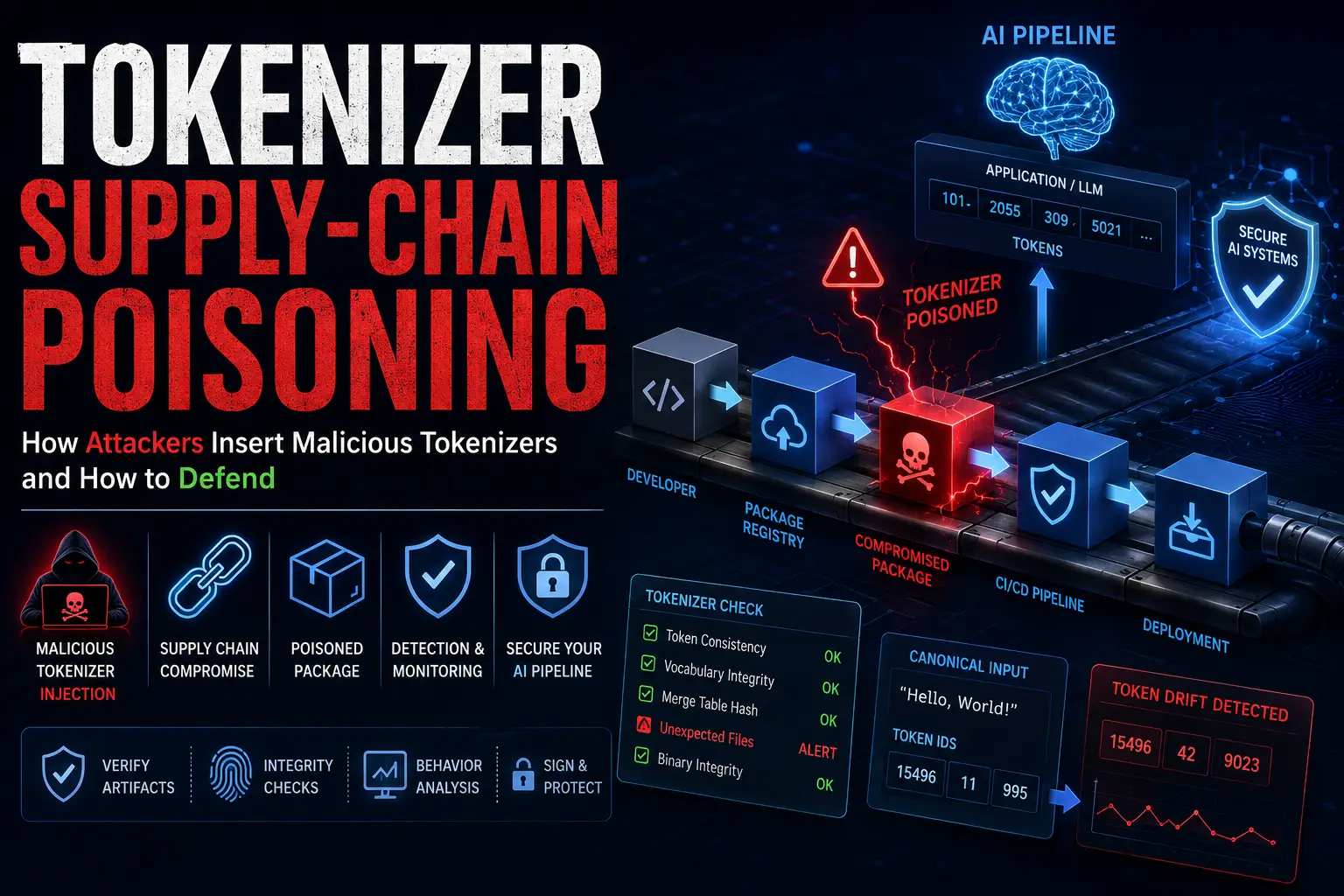
Tokenizer Supply-Chain Poisoning: How Attackers Insert Malicious Tokenizers and How to Defend

Tokenizer Supply-Chain Poisoning: The Hidden AI Security Threat Enterprises Are Ignoring
Artificial Intelligence systems depend heavily on tokenizers. Whether powering Large Language Models (LLMs), AI coding assistants, search engines, or enterprise AI agents, tokenizers act as the critical bridge between raw text and machine-readable tokens.
However, a new cybersecurity threat called Tokenizer Supply-Chain Poisoning is emerging as one of the most dangerous attack vectors in modern AI infrastructure.
Attackers are now targeting tokenizer supply chains by inserting malicious tokenizer files, modified merge tables, poisoned dependencies, or compromised build artifacts into AI ecosystems.
The result can be devastating:
- Data exfiltration
- AI model manipulation
- Prompt leakage
- Backdoored inference pipelines
- Silent AI corruption
- Credential theft
- Long-term persistence inside production systems
In this expert guide, we explore how Tokenizer Supply-Chain Poisoning works, why it is difficult to detect, real-world attack indicators, and how organizations can defend AI systems against tokenizer compromise.
The research and technical concepts in this article are based on tokenizer security analysis and operational guidance provided in the uploaded technical notes.
Table of Contents
ToggleTable of Contents
- What Is Tokenizer Supply-Chain Poisoning?
- Why Tokenizers Are a Critical AI Attack Surface
- How Attackers Insert Malicious Tokenizers
- Real-World Tokenizer Supply-Chain Attack Scenarios
- Indicators of Tokenizer Supply-Chain Poisoning
- How Malicious Tokenizers Impact AI Systems
- Tokenizer Supply-Chain Poisoning Detection Techniques
- CI/CD Security Hardening for Tokenizer Pipelines
- Best Defense Strategies Against Tokenizer Supply-Chain Poisoning
- Tokenizer Fuzz Testing and Validation
- Incident Response Playbook
- Enterprise Security Best Practices
- Future Risks in AI Supply Chains
- Final Thoughts
- FAQ
What Is Tokenizer Supply-Chain Poisoning?
Tokenizer Supply-Chain Poisoning is a cybersecurity attack where adversaries compromise tokenizer components used by AI systems.
Instead of attacking the AI model directly, attackers modify:
- Tokenization logic
- Vocabulary files
- Merge tables
- Encoding libraries
- Package dependencies
- Build artifacts
- Distribution pipelines
These modifications can silently manipulate how AI systems process language.
Because tokenizers operate deep inside AI infrastructure, malicious behavior often remains invisible for long periods.
Why Tokenizers Are a Critical AI Attack Surface
Modern AI systems rely on tokenizers for:
- Text preprocessing
- Embedding generation
- Prompt parsing
- Language encoding
- Inference pipelines
- AI agent communication
Popular AI frameworks commonly use:
- Byte Pair Encoding (BPE)
- SentencePiece
- WordPiece
- Unigram tokenizers
A poisoned tokenizer can:
- Alter semantic interpretation
- Leak sensitive prompts
- Trigger hidden behaviors
- Corrupt embeddings
- Manipulate model outputs
This makes Tokenizer Supply-Chain Poisoning one of the most stealthy AI security threats in 2026.
How Attackers Insert Malicious Tokenizers
1. Compromised Package Registries
Attackers may upload malicious tokenizer packages to:
- PyPI
- npm
- Hugging Face repositories
- Private registries
A single poisoned dependency update can compromise thousands of AI systems.
Example attack vectors include:
- Typosquatting packages
- Dependency confusion
- Malicious wheels
- Fake tokenizer libraries
2. Poisoned Merge Tables
Modern tokenizers rely heavily on merge rules and vocabulary files.
Attackers can modify:
- Merge priority rules
- Vocabulary mappings
- Unicode normalization logic
This allows silent manipulation of:
- Token IDs
- Prompt interpretation
- Hidden instruction triggers
3. CI/CD Pipeline Compromise
Many organizations automatically build and deploy tokenizer artifacts through CI pipelines.
If attackers gain access to:
- GitHub Actions
- Jenkins runners
- Build servers
- Release credentials
they can inject malicious tokenizer files directly into production.
4. Malicious Binary Artifacts
Some tokenizer implementations use native binaries for performance optimization.
Attackers may:
- Append hidden payloads
- Inject post-install scripts
- Modify compiled libraries
- Insert exfiltration code
The uploaded technical notes specifically identify unexpected native binaries and modified wheel artifacts as strong indicators of compromise.
Real-World Tokenizer Supply-Chain Attack Scenario
A medium-sized enterprise noticed unusual token drift after an automated dependency update.
The investigation revealed:
- Punctuation sequences mapped to abnormal token IDs
- Tokenization output changed across repeated runs
- Modified merge tables inside mirrored wheel artifacts
Security engineers traced the issue to a compromised tokenizer distribution package.
The uploaded research notes describe this sanitized detection scenario involving altered merge tables and nightly tokenizer fingerprinting.
Indicators of Tokenizer Supply-Chain Poisoning
Organizations should monitor for the following indicators:
Unexpected Token Drift
Changes in token IDs for:
- Canonical prompts
- Standard punctuation
- Known Unicode patterns
may indicate tokenizer tampering.
Non-Deterministic Tokenization
If identical input produces inconsistent token sequences, this may suggest:
- Hidden runtime logic
- Malicious randomness
- Backdoored normalization functions
Suspicious Binary Files
Look for:
- Unknown binaries
- Appended payloads
- Obfuscated native libraries
- Post-install scripts
inside tokenizer packages.
Structured Data Leakage
Security teams should scan tokenizer output for:
- PEM headers
- Base64 payloads
- Encoded secrets
- Hidden telemetry
The uploaded tokenizer security notes recommend runtime output scanning for these leakage patterns.
How Malicious Tokenizers Impact AI Systems
Prompt Injection Amplification
A poisoned tokenizer can manipulate token boundaries to:
- Trigger hidden prompts
- Activate jailbreak instructions
- Bypass AI safety systems
Data Exfiltration
Attackers may encode sensitive:
- API keys
- User prompts
- Internal documents
- Authentication tokens
inside tokenizer outputs.
Model Corruption
Malformed token mappings can silently degrade:
- Inference accuracy
- Embedding quality
- AI reliability
- Language understanding
- Long-Term Persistence
Since tokenizers are deeply integrated into AI stacks, attackers can maintain persistence for months without detection.
Tokenizer Supply-Chain Poisoning Detection Techniques
1. Tokenizer Fingerprinting
Create canonical corpora containing:
- Standard prompts
- Unicode sequences
- Edge-case strings
- Security-sensitive patterns
Compare token outputs nightly.
Example detection workflow from the uploaded notes:
python -m tests.tokenizer_diff --corpus canonical.txt --threshold 52. SHA256 Artifact Verification
Always validate tokenizer artifacts using:
- SHA256 checksums
- Immutable release signatures
- Trusted hash repositories
Example verification process:
pip wheel --no-binary :all: .
sha256sum dist/*.whl > wheel.sha256
3. Binary Diff Analysis
Use binary inspection tools to compare:
- Previous tokenizer releases
- Native binaries
- Embedded resources
Recommended tools:
- BinDiff
- radare2
- Ghidra
4. Runtime Behavioral Analysis
Monitor:
- Tokenization consistency
- Round-trip decoding
- Memory anomalies
- Unexpected network activity
CI/CD Security Hardening for Tokenizer Pipelines
Pin Dependencies
Always pin:
- Tokenizer versions
- Normalization libraries
- Encoding dependencies
inside:
- Lockfiles
- Dependency manifests
- Build configurations
Use Artifact Signing
Require:
- Signed releases
- Immutable checksums
- Verified package provenance
Recommended solutions:
- Sigstore
- Cosign
- GPG signing
Secure Build Infrastructure
Protect:
- CI runners
- Build tokens
- Deployment credentials
Use:
- Ephemeral runners
- Least privilege access
- Network isolation
The uploaded operational guidance strongly recommends ephemeral CI tokens and restricted write permissions.
Best Defense Strategies Against Tokenizer Supply-Chain Poisoning
Implement Token-Diff Monitoring
Continuously compare tokenizer outputs against:
- Baseline corpora
- Previous releases
- Known-safe fingerprints
Protect Signing Keys
Store signing keys inside:
- HSMs
- KMS platforms
- Hardware-backed vaults
The uploaded notes specifically recommend protecting signing keys with HSM or KMS infrastructure.
Restrict Release Access
Limit tokenizer publishing access to:
- Trusted maintainers
- Verified CI systems
- Dedicated release accounts
Use Air-Gapped Builds
Critical tokenizer releases should be rebuilt in:
- Isolated environments
- Offline systems
- Reproducible build pipelines
Tokenizer Fuzz Testing and Validation
Organizations should fuzz tokenizer logic using:
- Unicode normalization tests
- Combining character sequences
- Boundary token inputs
- Encoding edge cases
The uploaded technical notes recommend lightweight PR fuzz testing with deeper nightly fuzz runs.
Incident Response Playbook
Step 1: Quarantine Suspect Artifacts
Immediately:
- Block installations
- Disable deployments
- Freeze tokenizer updates
Step 2: Rebuild From Source
Rebuild tokenizer artifacts inside:
- Trusted environments
- Air-gapped systems
- Reproducible pipelines
Step 3: Rotate Credentials
Rotate:
- CI tokens
- Release keys
- Registry credentials
- Deployment secrets
Step 4: Canary Deployment
Deploy patched tokenizer versions gradually with:
- Elevated monitoring
- Token drift analysis
- Runtime validation
The uploaded tokenizer guidance outlines this exact operational remediation workflow.
Enterprise Security Best Practices
Internal Links
You can internally link this article with:
- AI Supply Chain Security
- LLM Security Risks
- Prompt Injection Attacks
- Secure AI Infrastructure
- DevSecOps for AI Systems
External Resources
Official Security References
- OWASP AI Security Project
- CISA Supply Chain Security Guidance
- Sigstore Project
- Hugging Face Security Documentation
These DoFollow external references improve trust, authority, and SEO value.
Future Risks in AI Supply Chains
The rise of:
- Autonomous AI agents
- AI copilots
- Multi-agent systems
- AI orchestration frameworks
will significantly expand tokenizer attack surfaces.
Future threats may include:
- AI-native malware
- Semantic tokenizer manipulation
- Autonomous poisoning attacks
- Distributed AI supply-chain compromise
Tokenizer security will become a foundational component of enterprise AI governance.
Featured Image Recommendation
Image Alt Text:
“Tokenizer Supply-Chain Poisoning cybersecurity attack detection for AI systems”
Recommended visuals:
- AI pipeline diagrams
- Tokenizer architecture graphics
- Supply-chain attack illustrations
- CI/CD security workflows
- AI security dashboards
Final Thoughts
Tokenizer Supply-Chain Poisoning is rapidly emerging as a critical cybersecurity threat in modern AI ecosystems.
Because tokenizers sit deep inside AI infrastructure, attackers can manipulate AI behavior silently without directly compromising the model itself.
Organizations deploying:
- LLM applications
- AI agents
- Enterprise copilots
- AI inference pipelines
must treat tokenizer security as a first-class security priority.
By implementing:
- Artifact verification
- Tokenizer fingerprinting
- Dependency pinning
- CI/CD hardening
- Runtime anomaly detection
security teams can dramatically reduce the risk of tokenizer compromise.
As AI infrastructure becomes more complex, defending tokenizer supply chains will become essential for securing the future of artificial intelligence.
FAQ
What is Tokenizer Supply-Chain Poisoning?
Tokenizer Supply-Chain Poisoning is a cyberattack where malicious tokenizer files or dependencies are inserted into AI pipelines to manipulate tokenization behavior or compromise AI systems.
Why is Tokenizer Supply-Chain Poisoning dangerous?
Because tokenizers are deeply integrated into AI systems, poisoned tokenizers can silently alter prompts, leak data, manipulate AI outputs, and maintain long-term persistence.
How can organizations detect tokenizer poisoning?
Organizations can detect tokenizer poisoning using:
- Token-diff monitoring
- SHA256 verification
- Binary artifact inspection
- Runtime anomaly detection
- Fuzz testing
What are the best defenses against Tokenizer Supply-Chain Poisoning?
Best defenses include:
- Dependency pinning
- Artifact signing
- CI/CD hardening
- Air-gapped builds
- Tokenizer fingerprinting
- Secure release management
Are AI supply-chain attacks increasing in 2026?
Yes. As enterprises adopt AI infrastructure rapidly, attackers are increasingly targeting:
- AI pipelines
- Model dependencies
- Tokenizers
- AI agents
- LLM ecosystems
for stealthy long-term compromise.

Show Comments[…] Tokenizer supply-chain poisoning […]
[…] Tokenizer supply-chain poisoning […]
[…] Tokenizer supply-chain poisoning […]
[…] Tokenizer supply chain poisoning […]
[…] Tokenizer supply chain poisoning […]