

Artificial Intelligence is transforming cybersecurity faster than any previous technological shift. From autonomous threat detection to AI-powered malware analysis, the cybersecurity industry is entering a new era where machine learning models can identify and stop attacks in seconds.
At the same time, cybercriminals are also using AI to create advanced phishing campaigns, automate ransomware attacks, and bypass traditional security systems. This growing AI arms race has created massive demand for next-generation security companies.
In 2026, AI security startups are attracting billions in investments as enterprises search for smarter ways to protect cloud infrastructure, applications, endpoints, and sensitive data.
In this article, we explore the top AI security startups in 2026 that are redefining digital defense with automation, machine learning, and intelligent threat detection.
Why AI Security Startups Are Exploding in 2026
Traditional cybersecurity tools often struggle to keep up with modern attacks because they rely heavily on predefined rules and manual analysis.
AI-powered cybersecurity platforms can:
- Detect anomalies in real time
- Predict threats before execution
- Automate incident response
- Analyze billions of security events instantly
- Reduce false positives
- Protect cloud-native environments
As enterprises adopt:
- AI agents
- Cloud infrastructure
- Remote work systems
- DevSecOps pipelines
- Autonomous workflows
the demand for intelligent security systems continues to grow rapidly.
According to industry analysts, the global AI cybersecurity market is expected to surpass hundreds of billions of dollars within the next decade.
What Makes a Great AI Security Startup?
The best AI security startups combine:
- Advanced machine learning
- Real-time threat intelligence
- Cloud-native architecture
- Security automation
- Enterprise scalability
- Low-latency detection systems
- Developer-friendly integrations
The companies on this list are not only innovating technologically but also shaping the future of enterprise defense.
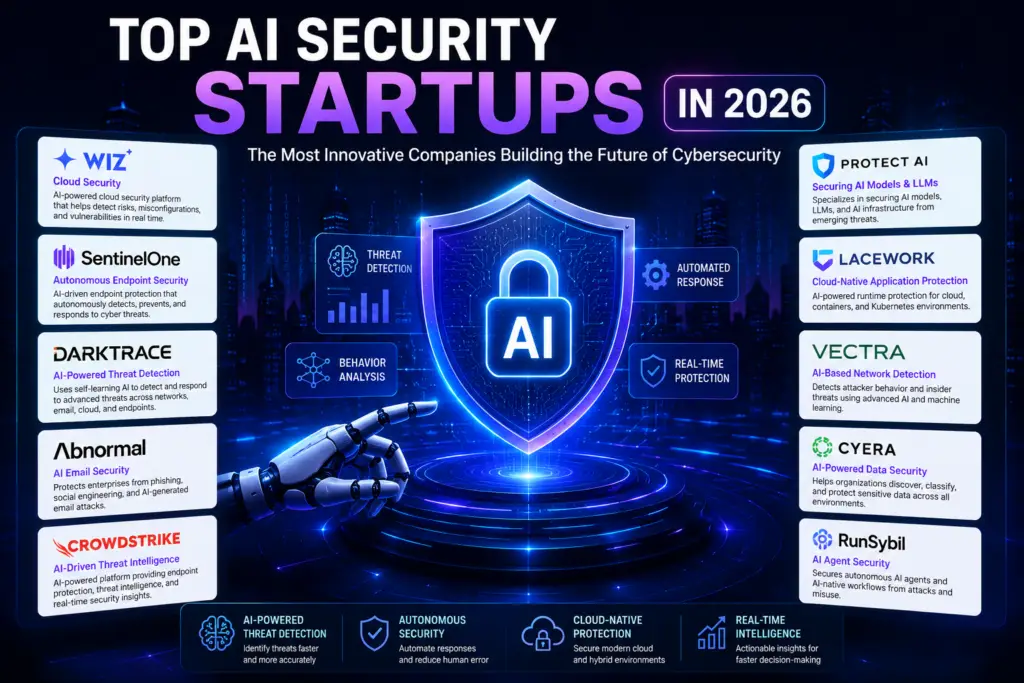
Top AI Security Startups in 2026
1. Wiz
Focus:
Cloud Security & AI-Powered Risk Detection
Wiz has rapidly become one of the most influential cloud security companies in the world. Its AI-powered platform helps organizations detect vulnerabilities, misconfigurations, exposed secrets, and cloud risks across multi-cloud environments, AI Security Startups.
Why it stands out in 2026:
- Agentless cloud scanning
- AI-driven risk prioritization
- Multi-cloud visibility
- Fast enterprise adoption
- Strong DevSecOps integration
Wiz is especially popular among enterprises using:
- AWS
- Azure
- Google Cloud
2. SentinelOne
Focus:
Autonomous Endpoint Security
SentinelOne uses AI to provide autonomous endpoint protection capable of detecting ransomware, malware, and advanced persistent threats without human intervention, AI Security Startups.
Key strengths:
- Behavioral AI detection
- Autonomous response engine
- Real-time threat remediation
- Cloud-native security operations
Its Singularity platform is widely used for enterprise endpoint security and AI-driven SOC operations.
3. Darktrace
Focus:
AI-Powered Threat Detection
Darktrace became famous for applying self-learning AI models to cybersecurity. The company analyzes network behavior patterns to detect insider threats, suspicious activities, and zero-day attacks, AI Security Startups.
Why enterprises use Darktrace:
- Self-learning AI systems
- Autonomous threat response
- Insider threat monitoring
- Network anomaly detection
Darktrace is particularly strong in large enterprise environments where massive network visibility is essential.
4. Abnormal Security
Focus:
AI Email & Phishing Protection
Abnormal Security Official Website
Phishing attacks continue to evolve rapidly in 2026, especially with generative AI helping attackers create convincing emails, AI Security Startups.
Abnormal Security uses behavioral AI to identify:
- Business email compromise
- AI-generated phishing campaigns
- Account takeovers
- Social engineering attacks
The platform integrates deeply with enterprise email ecosystems like:
- Microsoft 365
- Google Workspace
5. CrowdStrike
Focus:
AI-Driven Threat Intelligence
CrowdStrike remains one of the dominant names in modern cybersecurity thanks to its AI-powered Falcon platform, AI Security Startups.
Its security ecosystem includes:
- Endpoint detection and response
- Threat intelligence
- Cloud security
- Identity protection
- Managed SOC services
In 2026, CrowdStrike continues investing heavily in AI automation and predictive threat analysis.
6. Protect AI
Focus:
Securing AI Models & LLM Infrastructure
As AI applications become mainstream, securing machine learning systems themselves has become critical.
Protect AI focuses specifically on:
- LLM security
- Model scanning
- AI supply chain security
- Prompt injection protection
- AI model governance
This startup is gaining attention as organizations deploy AI agents and generative AI systems across business operations.
7. Lacework
Focus:
Cloud-Native Application Protection
Lacework uses AI and behavioral analytics to secure cloud environments and containers.
Major capabilities include:
- Kubernetes security
- Runtime monitoring
- Container threat detection
- Cloud compliance automation
- AI-driven anomaly detection
The company is popular among DevOps and cloud engineering teams.
8. Vectra AI
Focus:
AI-Based Network Detection & Response
Vectra AI focuses on detecting hidden attacker behavior inside enterprise networks using advanced machine learning.
The platform specializes in:
- Identity threat detection
- Hybrid cloud monitoring
- AI-based network analytics
- Autonomous investigation
Its technology helps SOC teams reduce alert fatigue and improve response speed.
9. Cyera
Focus:
AI-Powered Data Security
Data security is becoming one of the most important cybersecurity categories in 2026.
Cyera helps organizations:
- Discover sensitive data
- Prevent data leaks
- Monitor cloud data exposure
- Secure AI training datasets
The rise of generative AI has increased the need for protecting enterprise data pipelines and confidential information.
10. RunSybil
Focus:
AI Agent Security & Autonomous Defense
RunSybil is emerging as a startup focused on protecting autonomous AI agents and AI-native workflows.
Key areas include:
- AI agent monitoring
- Autonomous workflow security
- AI behavioral analysis
- LLM threat prevention
As AI agents become integrated into enterprise systems, companies like RunSybil may become increasingly important.
Major Trends Shaping AI Security in 2026
1. AI vs AI Cyber Warfare
Security companies are now using AI systems to fight AI-generated attacks. This includes:
- AI-generated phishing
- Deepfake scams
- Automated malware
- Prompt injection attacks
The cybersecurity battlefield is becoming increasingly autonomous.
2. AI Agent Security
Organizations are rapidly deploying:
- AI copilots
- Autonomous agents
- AI workflow automation
This creates new attack surfaces that require specialized protection systems.
3. Cloud-Native Security
Most modern startups are building:
- Cloud-native applications
- Kubernetes infrastructure
- Serverless systems
AI-powered cloud security platforms are now essential for securing these environments.
4. Security Automation
SOC teams are overwhelmed by massive amounts of alerts and attack data.
AI helps automate:
- Incident response
- Threat triage
- Log analysis
- Risk prioritization
- Vulnerability management
Which AI Security Startup Has the Most Potential?
Different startups dominate different areas:
| Startup | Specialization |
|---|---|
| Wiz | Cloud Security |
| SentinelOne | Endpoint Protection |
| Darktrace | Network AI Detection |
| Protect AI | LLM Security |
| Abnormal Security | Email Protection |
| Cyera | Data Security |
| Vectra AI | Threat Detection |
| CrowdStrike | Enterprise Security |
The market is still evolving rapidly, meaning new startups may emerge as major players over the next few years.
How Businesses Should Choose an AI Security Platform
Before adopting any AI security solution, organizations should evaluate:
- Integration capabilities
- Cloud compatibility
- AI transparency
- False positive rates
- Compliance support
- Scalability
- Threat intelligence quality
The best platform depends heavily on business size, infrastructure, and risk profile.
The Future of AI Security
AI security is no longer optional.
As businesses integrate:
- AI copilots
- Cloud-native systems
- Autonomous workflows
- AI coding assistants
- Generative AI applications
security platforms must evolve beyond traditional antivirus and rule-based detection systems.
The startups leading this transformation are building the foundation for the next generation of cybersecurity.
By 2030, AI-powered security automation could become the standard for nearly every enterprise environment.
Final Thoughts
The rise of AI is reshaping cybersecurity at every level. From cloud infrastructure to autonomous agents, organizations now face increasingly sophisticated digital threats that require intelligent defense systems.
The startups listed above represent some of the most innovative companies building the future of AI-powered cybersecurity in 2026.
As cyber threats evolve, expect AI security platforms to become smarter, faster, and more autonomous than ever before.
For businesses, developers, and cybersecurity professionals, staying informed about these emerging startups may provide a major competitive advantage in the years ahead.
FAQ
What is an AI security startup?
An AI security startup is a company that uses artificial intelligence and machine learning technologies to detect, prevent, and respond to cybersecurity threats.
Why is AI important in cybersecurity?
AI helps analyze massive amounts of data quickly, automate security operations, reduce false positives, and detect threats in real time.
Which AI security startup is best for cloud security?
Companies like Wiz and Lacework are considered strong leaders in cloud-native AI security.
What is AI agent security?
AI agent security focuses on protecting autonomous AI systems, workflows, and large language model applications from attacks and misuse.
Are AI cybersecurity tools replacing human analysts?
AI tools are helping automate repetitive tasks, but human expertise remains critical for advanced investigations, strategy, and decision-making.