

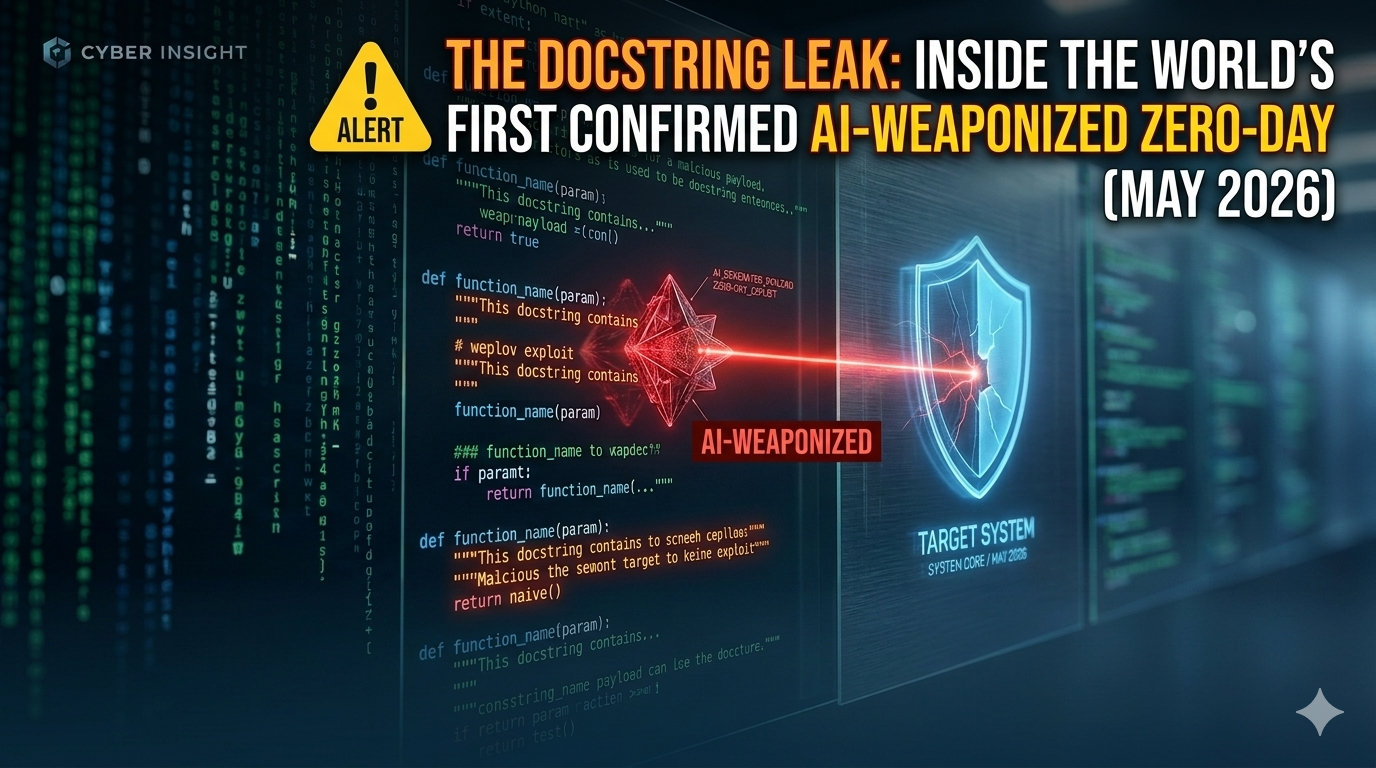
AI-Weaponized Zero-Day: Inside the APT45 Docstring Leak That Changed Cybersecurity Forever (2026)

the Google Threat Intelligence Group (GTIG) published a report that redefined the threat landscape: the first confirmed AI-weaponized zero-day exploit had been deployed in the wild by a state-sponsored actor. This was not a case of a human researcher using ChatGPT to draft a proof-of-concept. This was a fully autonomous campaign where discovery, exploit generation, validation, and payload delivery were executed by agentic AI systems operating at machine speed. The target was a semantic logic flaw in WebAdmin Pro, an open-source system administration tool used by over 12,000 enterprises worldwide. The attacker was APT45, a North Korean state-sponsored group that has systematically integrated large language models into its offensive cyber operations since late 2025.

Why This AI-Weaponized Zero-Day Is Different From Every Previous Attack
The cybersecurity industry has discussed AI-assisted attacks for years, but prior incidents involved humans using AI as a productivity multiplier. The May 2026 incident represents a categorical shift: the AI was not an assistant — it was the primary operator. GTIG’s forensic analysis revealed that the entire exploit development cycle, from initial reconnaissance to validated weaponization, completed in under 47 minutes. A comparable human-led effort by elite red teams typically requires 2 to 6 weeks of dedicated research.
This compression of the attack timeline from weeks to minutes is what makes the AI-weaponized zero-day an existential challenge for defenders. Traditional vulnerability management cycles assume a window of days or weeks between disclosure and exploitation. When an autonomous agent can discover, validate, and deploy a novel exploit faster than most organizations can triage a Jira ticket, the foundational assumptions of defensive security break down.
The Docstring Leak: How an LLM Hallucination Exposed APT45
The attribution breakthrough came from an unexpected source: the exploit code’s own documentation. The Python-based exploit script contained a detailed docstring that included a CVSS severity score of 11.5/10 — a value that is mathematically impossible under the CVSS v4.0 framework, which caps at 10.0. The docstring also referenced a CVE identifier (CVE-2026-99999) that had never been assigned by any CNA.
These were classic LLM hallucinations. The model understood that the vulnerability was “unprecedented in severity” and extrapolated a numerical score beyond the valid range. It also generated a plausible-looking but fictitious CVE number because its training data associated critical vulnerabilities with CVE identifiers. Human APT45 developers, who historically write minimal documentation in non-standard English, would never have produced textbook Pythonic docstrings with structured metadata. This stylistic and factual anomaly gave GTIG the attribution signal they needed.
The irony is significant: the very capability that made the AI-weaponized zero-day possible — fluent natural language generation embedded in code — also created the forensic artifact that unmasked it. However, defenders should not count on this advantage persisting. As models become more grounded and instruction-tuned against hallucination, future AI-generated exploits may leave no such traces.
The Vulnerability: Semantic Logic Flaws Are the New Frontier
The exploited vulnerability was not a memory corruption bug, SQL injection, or deserialization flaw. It was a semantic logic flaw in WebAdmin Pro’s two-factor authentication module. By chaining three specific API calls in a precise sequence with malformed parameters, the AI agent forced the authentication state machine into a fail-open condition where 2FA enforcement was silently bypassed for administrative sessions.
Semantic logic flaws are fundamentally different from traditional vulnerabilities because they exist in the intended behavior of the application rather than in implementation errors. Static analysis tools cannot detect them because the code is syntactically correct. Fuzzers rarely trigger them because they require multi-step stateful interactions rather than single-input mutations. These flaws have historically required elite human intuition to discover — exactly the capability gap that agentic AI systems are now closing.
The AI agent identified this flaw by performing exhaustive state-space exploration of the authentication API, testing over 14,000 parameter combinations across 200 parallel sessions in under 8 minutes. No human team could replicate this breadth of testing in the same timeframe. This industrial-scale semantic analysis is what makes the AI-weaponized zero-day so dangerous against complex modern applications.
Microsoft MDASH: AI-vs-AI Combat in Real Time
As APT45’s campaign scaled, it encountered a new defensive paradigm: Microsoft MDASH (Multi-Agent Defense Architecture for Security Hardening). MDASH deploys hundreds of specialized AI agents that operate in concert across the telemetry stack — network, identity, endpoint, cloud, and application layers — to detect, isolate, and remediate threats at agent speed.
In the WebAdmin Pro incident, MDASH agents detected anomalous API call patterns within 90 seconds of initial probing. Rather than blocking the traffic outright (which would alert the attacker and trigger adaptation), MDASH deployed a honey-patch: a temporary configuration change that appeared to allow the exploit to succeed while actually redirecting all attacker sessions into an instrumented sandbox environment. This allowed defenders to observe the AI agent’s full kill chain, extract its behavioral signatures, and develop permanent countermeasures without tipping off the adversary.
This AI-vs-AI engagement represents the future of cybersecurity. The compute infrastructure required to run MDASH-class defense systems is substantial — Microsoft reports a 1,000% increase in security-related AI compute demand since 2024 — but the alternative is defending against machine-speed attacks with human-speed processes.
8 Critical Defenses Against AI-Weaponized Zero-Day Exploits
Defense 1: Deploy Behavioral API Monitoring Beyond Signature Detection
Traditional WAFs and IDS systems rely on known signatures and pattern matching. AI-generated exploits are novel by definition and will not match existing signatures. Implement behavioral baselining for every critical API endpoint and alert on statistical deviations in call sequences, parameter distributions, timing patterns, and session state transitions. Tools like Salt Security, Noname, and Traceable AI specialize in this class of detection.
Defense 2: Adopt Agentic Red Team Testing Before Attackers Do
If autonomous agents can find semantic logic flaws in 47 minutes, your red team needs equivalent capabilities. Deploy agentic pentesting platforms like OpenClaw, PentestGPT Enterprise, or Noma Security to continuously probe your applications for logic flaws at machine scale. Schedule weekly automated campaigns against critical assets and integrate findings directly into your vulnerability management pipeline.
Defense 3: Implement Honey-Patches and Deception Layers
When facing AI-speed adversaries, blocking is often inferior to deception. Honey-patches allow you to observe attacker behavior, collect IOCs, and buy time for permanent remediation. Combine honey-patches with decoy credentials, fake API endpoints, and instrumented shadow environments to maximize intelligence collection from every engagement.
Defense 4: Enforce Continuous Adaptive Authentication
Static MFA is insufficient when AI agents can bypass authentication logic. Implement continuous adaptive authentication that evaluates behavioral biometrics, device posture, geolocation velocity, and interaction patterns throughout the session — not just at login. Re-authenticate or terminate sessions when risk scores exceed dynamic thresholds.
Defense 5: Segment Critical Assets With Micro-Perimeters
Assume that perimeter defenses will be breached at agent speed. Implement micro-segmentation around critical data stores, admin interfaces, and key management systems. Each segment should enforce independent authentication, authorization, and monitoring. An AI-weaponized zero-day that compromises one component should not grant lateral movement to adjacent systems.
Defense 6: Maintain Reversible Multi-Cloud Architectures
Avoid vendor lock-in to any single cloud provider’s AI defense ecosystem. If your primary provider’s AI defense system is itself targeted or experiences a failure, you must be able to shift workloads to an alternative platform within hours. Design for portability from day one using infrastructure-as-code, container orchestration, and abstraction layers.
Defense 7: Establish AI-Specific Incident Response Playbooks
Your existing IR playbooks assume human-speed adversaries. Create dedicated playbooks for AI-weaponized zero-day incidents that account for compressed timelines, automated containment triggers, pre-approved emergency change authority, and real-time coordination with AI defense platform vendors. Conduct quarterly tabletop exercises simulating agent-speed attacks.
Defense 8: Participate in Collective Defense Intelligence Sharing
No single organization can defend against AI-weaponized zero-day campaigns alone. Participate in ISACs, contribute to shared threat intelligence platforms, and engage with vendors like GTIG, Mandiant, and CrowdStrike who aggregate cross-organizational telemetry. The behavioral signatures extracted from one organization’s honey-patch deployment become the detection rules for the entire community.
Timeline: Anatomy of the May 2026 AI-Weaponized Zero-Day Campaign
| Timestamp (UTC) | Event | Duration |
|---|---|---|
| May 11, 02:14 | APT45 AI agent begins reconnaissance of WebAdmin Pro instances | — |
| May 11, 02:22 | Agent identifies semantic logic flaw in 2FA module via state-space exploration | 8 min |
| May 11, 02:31 | Exploit code generated, validated, and documented with hallucinated metadata | 9 min |
| May 11, 02:47 | Weaponized payload deployed against first target cluster | 16 min |
| May 11, 02:49 | MDASH agents detect anomalous API patterns | 2 min |
| May 11, 02:51 | Honey-patch deployed; attacker redirected to sandbox | 2 min |
| May 11, 03:30 | Full kill chain observed and behavioral signatures extracted | 39 min |
| May 11, 06:00 | GTIG publishes advisory; vendor patch available | 3 hrs |
Internal Resources
- RAG Poisoning: 7 Critical Defenses for AI Systems
- OAuth Consent Phishing: MFA Bypass Defense Controls
- GitHub Actions Tag Hijack: Supply Chain Defense Controls
Authoritative External References
- Google Threat Intelligence Group — AI-Weaponized Exploit Report (May 2026)
- CISA Advisory — Agentic AI Cyber Threats (May 2026)
- Microsoft Learn — MDASH Multi-Agent Defense Architecture
- arXiv — Autonomous Exploit Generation via Large Language Model Agents (2026)
Frequently Asked Questions
What makes an AI-weaponized zero-day different from AI-assisted hacking?
AI-assisted hacking involves a human directing AI tools to accelerate specific tasks like code generation or reconnaissance. An AI-weaponized zero-day involves autonomous agents executing the entire attack lifecycle — discovery, exploit development, validation, and deployment — without real-time human direction. The distinction matters because autonomous agents operate at machine speed and scale, compressing attack timelines from weeks to minutes.
Can traditional vulnerability scanners detect semantic logic flaws?
Generally no. Traditional scanners excel at identifying known vulnerability patterns, misconfigurations, and outdated dependencies. Semantic logic flaws exist in the intended behavior of correctly implemented code and require stateful, multi-step reasoning to discover. This is precisely the capability gap that agentic AI systems are filling on both the offensive and defensive sides.
Will LLM hallucinations continue to help defenders attribute AI-generated attacks?
Unlikely. Current-generation models hallucinate frequently enough to create forensic artifacts, but model providers are actively reducing hallucination rates through reinforcement learning, grounding techniques, and fact-checking pipelines. Defenders should treat hallucination-based attribution as a temporary advantage and invest in behavioral detection, telemetry correlation, and deception-based intelligence collection as durable alternatives.
How should small teams without MDASH-class budgets defend against AI-weaponized zero-days?
Prioritize behavioral API monitoring, aggressive micro-segmentation, and participation in collective defense communities. Open-source agentic testing tools like OpenClaw provide accessible entry points for automated logic flaw discovery. Focus on reducing blast radius through architecture rather than trying to match nation-state AI compute dollar-for-dollar.
Is the AI-weaponized zero-day threat limited to state-sponsored actors?
Not for long. While the May 2026 incident involved APT45, the underlying agentic frameworks and fine-tuned models are proliferating through underground forums and open-source repositories. Expect criminal groups and less-resourced threat actors to adopt similar capabilities within 6 to 12 months as tooling matures and barriers to entry decrease.