

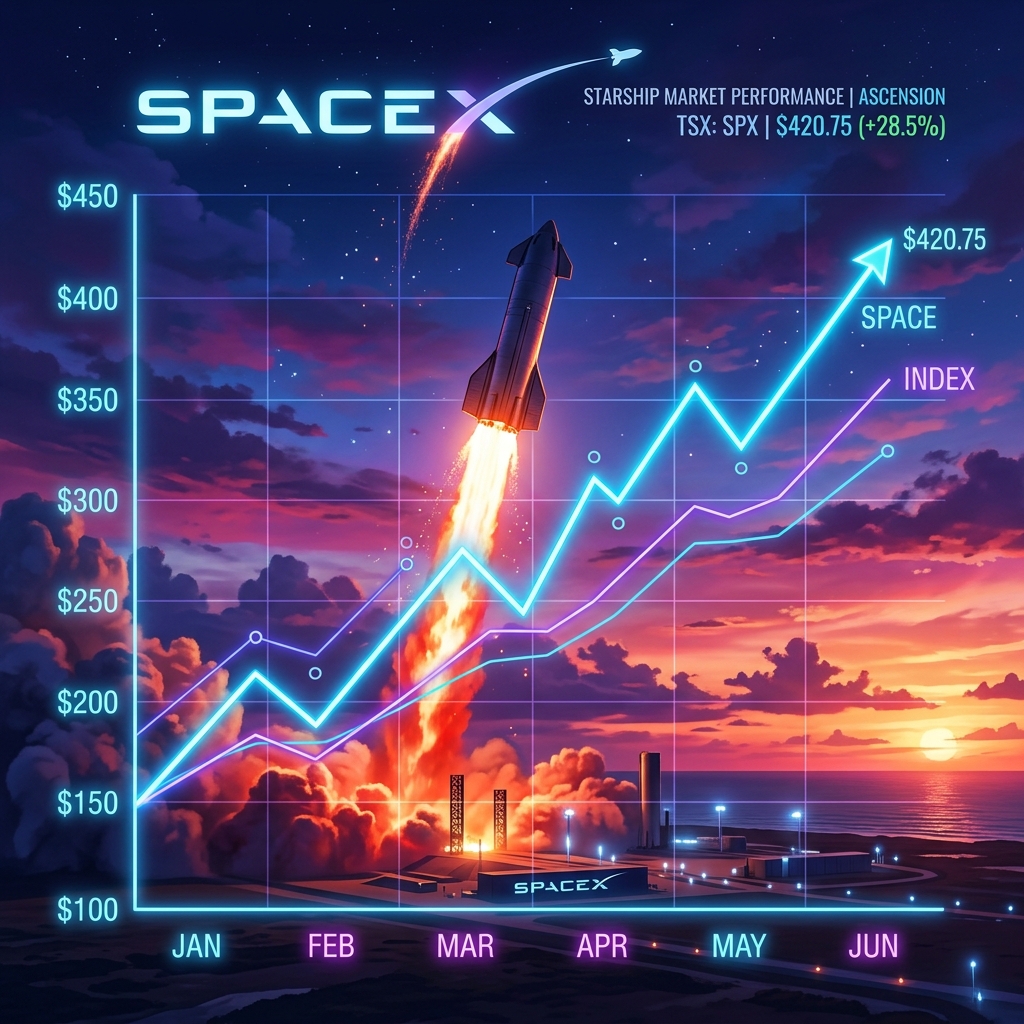
SpaceX IPO: Stunning $2T Nasdaq Debut Triggers Crypto Squeeze & 10-Year Growth Debate

SpaceX IPO: Stunning $2T Nasdaq Debut Triggers Crypto Squeeze & 10-Year Growth Debate
On June 12, 2026, the financial landscape witnessed a historic milestone. The historic SpaceX IPO officially took place on the Nasdaq (ticker: SPCX). In what is now officially recorded as the largest initial public offering (IPO) in financial history, the SpaceX IPO finalized its offering price at $135.00 per share, valuing the aerospace giant at a staggering $1.77 trillion. However, public demand immediately sent shockwaves through the market, with the stock opening at $150.00 and surging to $160.00–$165.00 during its first day of trading, pushing the company’s valuation past the historic $2.0 trillion mark.
Yet, the excitement of this monumental launch has been overshadowed by a major retail squeeze in the cryptocurrency and synthetic asset markets. Several major crypto exchanges, including Binance, Bybit, and Bitget, have been forced to abruptly cancel their pre-IPO allocation campaigns and issue full refunds to disappointed retail traders after underwriters failed to secure the underlying shares. Here, we analyze the mechanics of the SpaceX IPO, the crypto allocation failure, and the long-term outlook for the world’s most valuable aerospace enterprise.
SpaceX IPO: Core Market Statistics
To understand the sheer scale of the SpaceX IPO public debut, the following table summarizes the key financial metrics of the IPO launch on June 12, 2026:
| Financial Metric | Details / Values |
|---|---|
| Nasdaq Ticker Symbol | SPCX |
| Finalized IPO Price | $135.00 per share |
| Nasdaq Opening Price | $150.00 per share |
| First-Day Trading Range | $160.00 – $165.00 per share |
| Implied Valuation (at IPO) | $1.77 Trillion |
| Market Cap (First-Day Close) | $2.12 Trillion (approximate) |
| Underwriters | Morgan Stanley, Goldman Sachs, JPMorgan Chase |
The Pre-IPO Squeeze: Why Crypto Exchanges Canceled Allocations
In the weeks leading up to the SpaceX IPO, several major cryptocurrency exchanges launched subscription campaigns offering “tokenized pre-IPO allocations.” These products were designed to give retail investors and crypto traders early exposure to SpaceX shares prior to the public listing. However, when the shares were finally distributed on June 12, 2026, the exchanges found themselves entirely locked out of the allocation process.
BREAKING: Binance, Bybit, and Bitget cancel SpaceX IPO allocations and issue full refunds after failing to secure the underlying shares.
The core issue stems from an extreme supply shortage and the allocation strategy of the leading IPO underwriters (Morgan Stanley, Goldman Sachs, and JPMorgan Chase). Faced with unprecedented institutional demand for the SpaceX IPO from sovereign wealth funds, pension funds, and major asset managers, underwriters prioritized institutional giants. Retail-oriented crypto platforms that attempted to secure shares through intermediary broker-dealers were completely squeezed out.
How the Platforms Responded
- Bybit: Confirmed that its “IPO Express” program received a 0% allocation due to the broker-dealer’s inability to deliver the underlying assets. Bybit immediately initiated a 100% refund of all subscription funds and went a step further, offering users an additional compensation calculated at a 10% annualized interest rate for the four-day holding period.
- Binance: Announced that its “SpaceX IPO Campaign” could not proceed due to factors beyond its control. The platform initiated full refunds of all BNB, USDT, and FDUSD deposits to users’ spot wallets, citing a failure of their custodial partners to secure the physical share allocations.
- Bitget & Kraken: Bitget issued a total recall of its pre-IPO subscription vouchers for the SpaceX IPO campaign, returning all staked capital. Kraken, which offered a similar synthetic access product, was only able to partially fill orders, refunding the unfilled portion to users’ accounts.
Derivative Workaround: Tokenized Allocations vs. Perpetual Futures
It is vital for traders to distinguish between the two types of SpaceX products that were trading in the crypto space. The Tokenized IPO Allocations were direct, share-backed contracts that failed due to physical share delivery issues, resulting in the refunds. In contrast, SpaceX Pre-IPO Perpetual Futures (such as those offered on Bitget and various decentralized derivative platforms) are purely synthetic cash-settled contracts tracking the speculative price of SpaceX. These futures contracts did not rely on physical share allocations and continued to trade, experiencing extreme volatility as the official SpaceX IPO trading commenced.
Market Sentiment: The Bull vs. Bear Debate
The $2 trillion valuation following the SpaceX IPO has ignited an intense debate among retail traders, institutional analysts, and market experts. With SpaceX now trading as a public entity on the Nasdaq SPCX market page, the market is pricing in the future of interplanetary infrastructure.
The Bull Case: The Interplanetary Monopoly
Professional bulls argue that SpaceX is not a mere aerospace company, but a multi-vertical monopoly controlling the gateway to the orbital economy. Key drivers of the bull case include:
- Starlink V3 and Direct-to-Cell: Starlink is already generating billions in high-margin cash flow. The deployment of Starlink V3 satellites, which offer direct-to-cell voice and data connectivity to unmodified smartphones globally, is projected to disrupt the global telecom market.
- Starship Commercial Dominance: With Starship approaching regular operational cadence, the cost per kilogram to orbit is projected to drop below $100. This unmatched cost efficiency completely locks out legacy competitors like United Launch Alliance (ULA) and Arianespace.
- Elon Musk’s Net Worth & Trillionaire Status: Musk holds an estimated 42% equity stake in SpaceX. Following the SpaceX IPO, and his stakes in Tesla, xAI, and Neuralink, this public listing officially positions Elon Musk to become the world’s first verified trillionaire, drawing massive retail interest and “meme premium” to the stock.
The Bear Case: Capex and Concentrated Risk
Conversely, professional bears and institutional skeptics warn that the current valuation is highly speculative. Their arguments center on:
- Astronomical Capital Expenditures (Capex): Building Mars-class infrastructure and launching tens of thousands of satellites requires continuous, massive capital outlays. The cash flow from Starlink must constantly be reinvested to maintain and replace aging low-Earth-orbit satellites.
- Regulatory & Geopolitical Dependencies: A significant portion of SpaceX’s core revenue remains tied to government contracts with NASA and the U.S. Department of Defense (DoD). Any shift in political administration or regulatory hurdles from the FAA could halt operations, as registered in official SEC filing registrations.
- Valuation Multiples: At $2 trillion, SpaceX is trading at trailing price-to-sales multiples that far exceed any traditional aerospace, defense, or telecom provider, leaving no margin for operational error.
SpaceX Growth Projections: 1, 2, 5, and 10+ Years
How will SpaceX navigate the public markets over the next decade following the SpaceX IPO? Based on institutional research, inside leaks from the company’s financial roadmap, and market data, we project the following trajectory:
Short-Term: 1 to 2 Years (2027–2028)
We expect SpaceX to focus on consolidating its public listing and stabilizing its balance sheet. High priority will be placed on commercializing Starship, executing the first crewed Artemis lunar landings with NASA, and rolling out Starlink’s direct-to-cell commercial packages globally. Projections place the stock within the $180.00–$210.00 range, representing a steady 15-20% annualized growth as Starlink’s cash flows begin to fully offset Starship development costs.
Medium-Term: 5 Years (2031)
By 2031, Starlink is projected to capture over 30% of the global rural broadband and commercial aviation/maritime connectivity market. Starship is expected to be fully reusable, conducting dozens of flights per month. This period will likely see the first uncrewed cargo flights to Mars. With revenue diversifying into orbital manufacturing and national security defense networks (Starshield), the valuation is projected to reach $3.2–$3.5 trillion.
Long-Term: 10+ Years (2036 and Beyond)
Over a ten-year horizon, SpaceX is positioned to lead the interplanetary economy. The primary growth driver will shift from satellite internet to Mars colonization logistics, asteroid mining support, and point-to-point suborbital passenger travel on Earth (reducing transit times between major cities to under 45 minutes). Experts predict that if Starship succeeds in opening the solar system for commercial exploitation, SpaceX will become the world’s first $5.0+ trillion enterprise.
Frequently Asked Questions (FAQ)
What is the ticker symbol for SpaceX and where does it trade?
SpaceX trades on the Nasdaq Global Select Market under the ticker symbol SPCX. It officially listed on June 12, 2026.
What was the SpaceX IPO price and initial valuation?
The SpaceX IPO price was finalized at $135.00 per share, giving the company an initial valuation of $1.77 trillion. The stock opened at $150.00 and quickly surged past $160.00, pushing the valuation over $2.0 trillion.
Why did Binance, Bybit, and Bitget cancel their SpaceX IPO allocations?
Due to extreme demand and a limited supply of shares, the underwriters prioritized large institutional investors. As a result, the intermediary broker-dealers serving these cryptocurrency platforms failed to secure the physical shares, forcing the exchanges to cancel their campaigns and issue full refunds.
Did users receive compensation for the canceled Bybit SpaceX allocations?
Yes. In addition to a full 100% refund of the subscription capital, Bybit provided users with additional compensation equivalent to a 10% annualized interest rate based on their subscription amount for the 4-day holding period.
Is Elon Musk a trillionaire following the SpaceX IPO?
Yes. Holding an approximate 42% equity stake in SpaceX, the surge in SPCX share price past $160.00 (valuing SpaceX at over $2 trillion) has pushed Elon Musk’s personal net worth beyond the $1 trillion threshold, making him the world’s first official trillionaire.
Recommended Reading: To see how other tech sectors are performing in mid-2026, read our comprehensive review: The 2026 AI War: Claude Fable 5 vs. OpenAI GPT-5.5 vs. Alibaba Qwen 3.


[…] intelligence boom faces a major structural threat. The updated prospectus highlights a critical SpaceX IPO AI risk: growing regional water scarcity. This environmental crisis threatens to choke the […]